
Composers nearly always have some self-limiting parameters in place before diving into a new project. In traditional tonality, composers would restrict themselves to diatonic tones of a particular key and a few chromatic alterations (provided they eventually lead back to the core diatonic tones in some way). Rhythm and form were often determined by stylistic dictates. Composers in more recent times find themselves unbound to any sort of tradition and have found many novel ways to narrow their focus (dodecaphony and its various permutations perhaps being the most influential and widely-used).
One “filter” I’ve been curious to try is that of interval restriction. In this case, a composer chooses a particular interval to predominate in the piece–melodically, harmonically, or both.
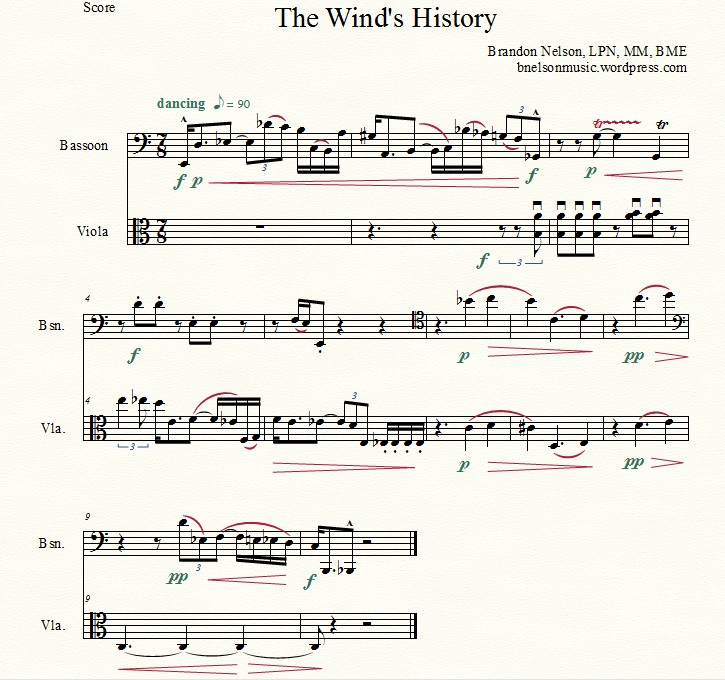
For this project (a short poem), I decide I want to explore the seventh. I will score it for bassoon and viola. I will use the major and minor 7th and I will allow myself use of the inversion, the major/minor 2nd. Use of any other intervals, I feel, would muddy the point of restricting intervals (though I could see using it merely as a jumping off point, should the muse strike, in larger projects). I could also decide that the 7th will dictate other parameters (phrasing in 7s, rhythmic units tied in some way to 7, etc.) but I choose to be freer in that regard.


 Brandon Nelson
Leave a reply to Michel Plourde Cancel reply