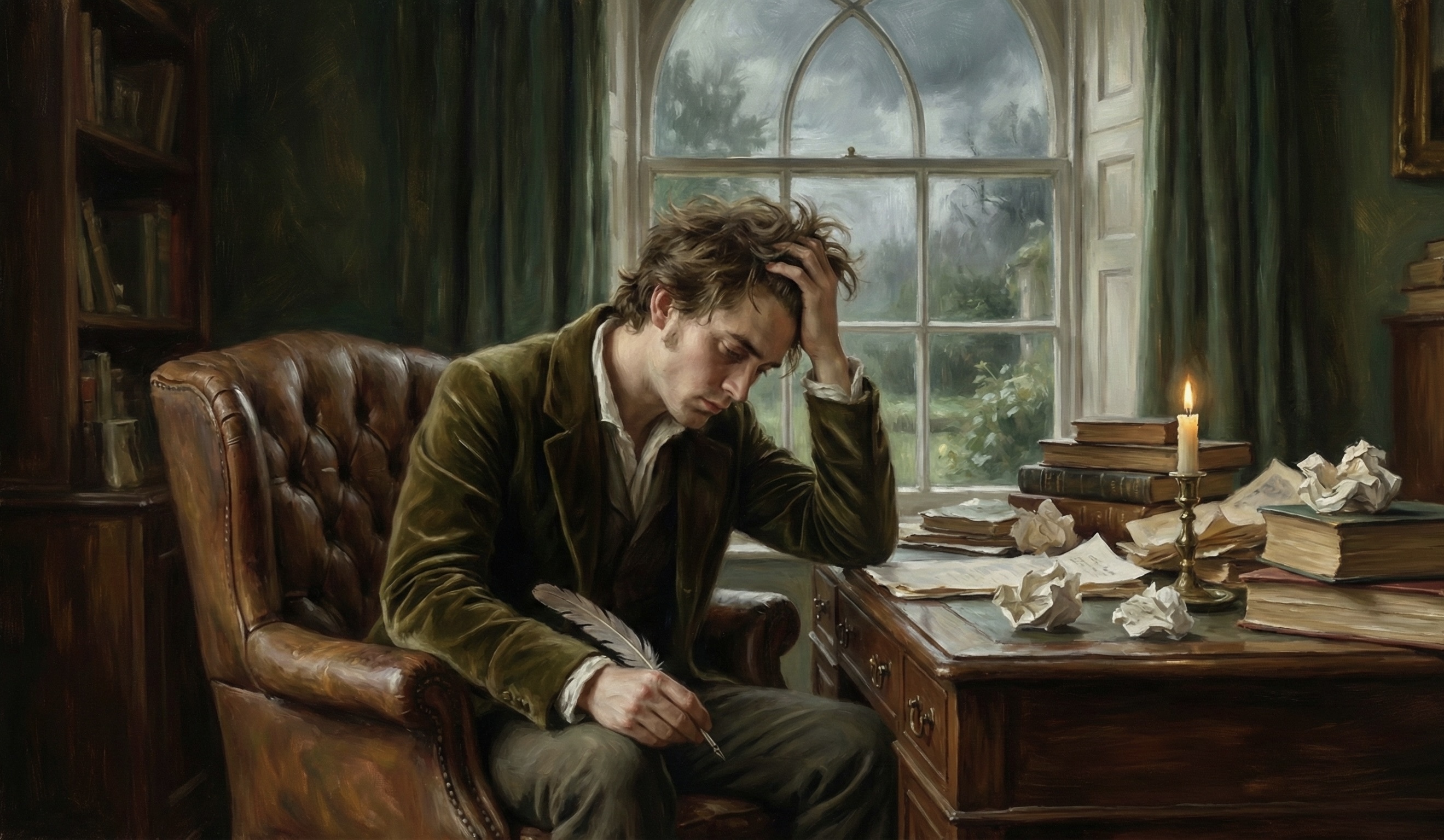
I have wanted to write books and other matters not strictly about music for some time.
Well, I have accomplished this task with my first full-length book, which has to do with the Catholic concept of the imago Dei and its intersection with creativity. I am currently pursuing publication, but I am posting here the preface and the introduction to give you an idea of what the book will be about.
PREFACE
I am not a theologian. I am a composer and an artist.
I spend my days wrestling with frequencies and forms, with the stubborn physics of sound and the resistance of pigment. For years, I lived a sort of double life. On Sundays, I professed a faith that claimed the world was charged with the grandeur of God. On Mondays, I went into the studio and worked as if the material world were merely dead stuff to be manipulated.
I wrote this book because I needed to read it. I needed to understand how the Incarnation wasn’t just a dogma to be recited in the Creed, but the operating manual for my work. I needed to know if the “agony of the will” I felt when a composition wasn’t working, or when a painting refused to coalesce, had any spiritual value.
This book is an attempt to bridge the gap between the seminary and the studio. It is written for the creators—the parents, the workers, the artists—who suspect that their labor is not a distraction from God, but a way to Him.
— B.N.
INTRODUCTION
The World Without Windows
The Malaise of the Immanent Frame
We live in an age that suffers from a peculiar and specific form of metaphysical claustrophobia.
The Canadian philosopher Charles Taylor, in his magisterial work A Secular Age, describes the modern condition as living within an “immanent frame.” To understand what this means, we must look backward. For the vast majority of human history, the human “self” was considered “porous.” It was open to the influence of the world outside of it—spirits, demons, grace, and the divine. The boundary between the natural and the supernatural was thin, permeable, and constantly trafficked. A thunderstorm was not just weather; it was a voice. A plague was not just a virus; it was a judgment. The world was charged with meaning.
But the modern West has constructed a “buffered self.” For the first time in history, it is possible for a civilization to conduct its daily business entirely within the horizon of the natural world, without any reference to a transcendent order.
For the modern materialist, the universe is a closed system—a room with no windows. In this view, matter is merely matter, governed by blind mechanics, chemical reactions, and biological imperatives. A tree is just a collection of cellulose and chlorophyll; a mountain is a geological accident; a human face is a biological survival strategy developed over millions of years of evolutionary pressure. There is no “beyond,” no light shining through the cracks of the physical world, because the modern worldview insists there are no cracks.
The Spiritual Diagnosis: Acedia
This flattening of reality has resulted in what sociologists call “disenchantment,” but for the Catholic, the diagnosis is far worse. It is a denial of our deepest ontological structure.
We feel the weight of this ceiling. We sense that the physical world is not a wall, but a veil—thin, porous, and trembling with a presence that is just on the other side. Because we are denied this access, we suffer from a spiritual boredom. The Desert Fathers called this Acedia (the “noonday devil”).
Acedia is often mistranslated as “laziness,” but it is actually a sorrow about the spiritual good. It is a cramping of the soul that comes from living in a world that is too small for us. We are whales trying to swim in a bathtub. We fill the void with noise, entertainment, and endless scrolling, but the hunger remains. We are starving for the Transcendent, but we have been told that the only thing on the menu is the Material.
The purpose of this book is to tear down the drywall of a strictly materialist universe and reveal the windows. We do this by exploring the intersection of the Imago Dei—the Image of God—and the human impulse to create.
The Missing Third Faculty
For centuries, the Church has taught that man is made in the Image of God. In our catechisms, seminaries, and pulpits, this is traditionally discussed in terms of the two great spiritual faculties: Intellect and Will.
- We are like God because we can Know truth (Intellect).
- We are like God because we can Choose the good (Will).
These are the pillars of our moral anthropology, and they distinguish us from the beasts. But there is a third, vital dimension to the Divine nature that we mirror, one that is often relegated to the sidelines of theological discussion or treated as a mere hobby: God is a Creator.
The God of Genesis does not merely contemplate Himself in static eternity; He acts. He speaks, and reality bursts forth from nothingness. He shapes the dust and breathes life into it. He calls the stars by name and delights in their existence. He is the Archetype of the Artist.
If we are truly made in His image, then we cannot be content to merely exist, nor merely to analyze, nor merely to obey moral laws. We are driven by a holy restlessness to make, to shape, and to reorder.
- When a mother arranges a home to facilitate peace…
- When a carpenter joins wood to create a table…
- When a poet wrestles with language to find the precise word…
- When a coder designs an elegant algorithm…
They are not just engaging in a leisure activity. They are echoing the “Fiat” of Genesis. They are acting out their family resemblance.
The Sacramental Thesis
However, in the context of our faith, this creativity is not just about self-expression or therapeutic release. It is strictly theological. This brings us to the central thesis of our exploration, which acts as the spine of this entire book:
Because the Word was made flesh, human creativity serves a sacramental function: it makes the invisible mysteries of God visible. The creative act is the primary way the human person exercises their likeness to God, bridging the gap between the spiritual and the material.
This is what we shall call the “Sacramental Imagination.”
In Catholic theology, a sacrament (with a capital ‘S’) is an outward sign instituted by Christ to give grace. It uses physical matter—water, oil, bread, wine—to convey invisible realities. Analogously, human creativity uses the materials of this earth—pigment, stone, sound waves, language, fabric—to convey invisible truths.
We are rejecting two opposing errors:
- Materialism: Which says matter is all there is (the world is a wall).
- Gnosticism: Which says matter is evil and we must escape it to find God (the world is a trap).
The Sacramental view says that matter is a vessel. When the Word became Flesh in the Incarnation, God permanently validated the physical world. He showed us that the spiritual does not despise the material; it inhabits it. Therefore, the Catholic creative is not trying to escape the world to find God. We are called to dive deeper into the mystery of the world to reveal Him. We are called to show that the world is not a windowless room, but a cathedral where every stone and pane of glass speaks of the Architect.
The Roadmap
In the chapters that follow, we will journey through the theology, anthropology, warfare, and application of this vocation.
- Part I: The Theology of Making. We begin with the foundation. We will explore how the Incarnation shattered the old prohibition against images (Chapter 1), how Creation itself is a “Book” waiting to be read (Chapter 2), and how the Virgin Mary acts as the supreme model of the artist in her “Fiat” (Chapter 3).
- Part II: The Anthropology. We turn inward to the human person. We will examine how our senses act as gateways to the soul (Chapter 4) and how the intellect and will cooperate to birth ideas into reality (Chapter 5).
- Part III: The Warfare of the Imagination. We must be honest about the struggle. We will confront the three great enemies of the modern creative: The Idol of Utility (Chapter 6), The Gluttony of the Eye (Chapter 7), and The Death of Silence (Chapter 8).
- Part IV: The Application. Finally, we move to the practical. We will look at where this creativity takes flesh: in the Liturgy (Chapter 9), the Domestic Church (Chapter 10), the Workplace (Chapter 11), and the wider Culture (Chapter 12).
Along the way, we will pause for Interludes—brief narrative profiles of the masters who have gone before us, from Bezalel in the desert to Messiaen in the prison camp. They act as our guides.
We are about to argue that your impulse to create—whether you are painting a masterpiece, fixing an engine, or setting a table—is not a distraction from your spiritual life. It is the very means by which you make the invisible God visible to a watching world.
 Brandon Nelson