Commissioned by Brian Wilson for his Oshkosh West High School Varsity Concert band.
Currently under revision.
IMAGO DEI
Commissioned by Brian Wilson for his Oshkosh West High School Varsity Concert band.
Currently under revision.
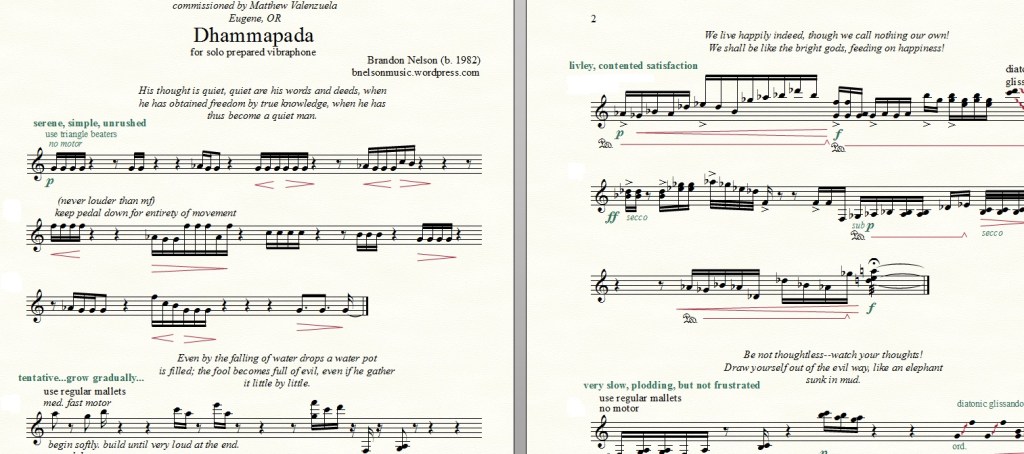
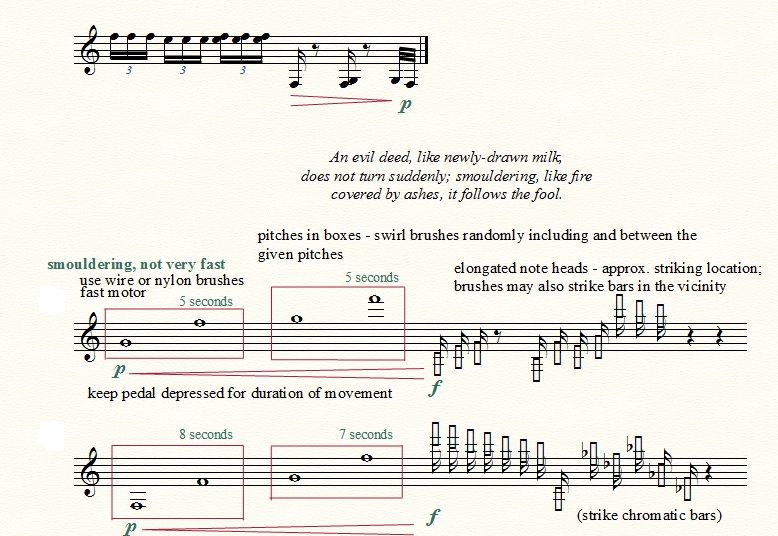
Commissioned by Matthew Valenzuela (Eugene, OR)

The Dhammapada (or “Path to Virtue”) is a compilation of concise yet profound teachings on the basic values and ethics of Buddhism. Often using down-to-earth imagery to illustrate its points, these ancient texts transcend the limitations of time, tradition, and culture to express the great wisdom and compassion that Gautama Buddha himself originally taught.
The five movements of this piece are musical paintings of particularly vivid teachings found in the Dhamapada. Each is a meditation on both the literal image and the underlying philosophy of the chosen verse. In the Buddhist tradition of detaching from one’s ego, I chose to apply chance techniques to assist in making many important musical decisions, including rhythm and form.
Namaste.
A great piece to show off the talents of mature flute and lever harp performers, this colorful character piece is appropriate for any recital or concert setting. Mannanàn mac Lir occupied several roles in the mythological universe of the Celtic peoples. Most notably, he was considered to be the god of the seas. He was also regarded as a “psychopomp”-that is, a figure associated with the realm of the dead, acting as a sort of “veil” between the worlds.
In this work, I play on his connection to the sea by quoting the traditional Manx folk tune “The Storm Is Up” (Callin Veg Dhoan). The tune is developed through several permutations, each portraying a role Mannanàn played. Each movement is ushered to us by a psychopomp veil.
“With the Churl in the Drab Coat” refers to Mannanàn’s association with the trickster figure Bodach an Chota Lachtna. The movement is erratic yet impishly playful.Mannanàn was also regarded as a sort of magician king. In that respect, he was given the role of Guardian of Mag Mell, a place that is comparable to the Nordic conception of Valhalla. Mag Mell was a plain of joy, a kingdom under the sea for a select few. Mannanàn protected this realm with the help of Fragarach, a sword which could slice through any armor and could compel anyone to tell the truth. This movement is bold and heavy in spirit, gradually becoming more dissonant as if portraying an ugly battle to defend this beautiful place.
The final veil transports us to the end of times, a fading away of the once-great pantheon. That storm, as all must do, comes to a quiet, peaceful end.
Get the music here!

According to Homer (Odyssey iv:412), the sandy island of Pharos, situated off the coast of the Nile delta, was the home of Proteus, the old god of the sea. In the Odyssey, Menelaus relates to Telemachus that he had been becalmed here on his journey home from the Trojan War. He learned from Proteus’ daughter Eidothea that if he could capture her father, he could force him to reveal which of the gods he had offended and how he could propitiate them and return home. Proteus emerged from the sea to sleep among his colony of seals, but Menelaus was successful in holding him, though Proteus took the forms of a lion, a serpent, a leopard, a pig, even of water or a tree. Proteus then answered truthfully, further informing Menelaus that his brother Agamemnon had been murdered on his return home, that Ajax the Lesser had been shipwrecked and killed, and that Odysseus was stranded on Calypso’s Isle Ogygia.
This piece, for solo tenor sax, illustrates that mighty conflict between Menelaus and Proteus. Each movement illustrates a different form the god took in his attempt to evade sharing his knowledge. The rhythmic motives are based on the ancient Greek poetic meters. I translated these patterns of long and short sounds to musical notation (using the sixteenth note as the basic unit). I randomized the order and deployed the resulting phrase as a sort of idee fixe. Each movement uses this rhythmic idea beginning at a different point. The melodic content is based on a pentatonic set and its permutations, primarily its modes. I arrayed these pitches into a grid (not unlike the matrix used in dodecaphonic music) and assigned pitches to the rhythmic motives using differing deployment schemes (rotation, chaining, etc).
Commissioned by Lisa Hanson-Bartholow for the Peachtree Consort (Atlanta, GA).

Giovanni Battista Bracelli (1584-1609) was an Italian engraver and painter of the Baroque period. He is best known for his book of prints: Bizzarie di varie figure, published in 1624 in Livorno, and dedicated to Don Pietro Medici. The depiction of a variety of human shapes aggregated from a variety of objects or landscapes appears prescient of modern cubist experiments. Some of the figures are composed of boxes or raquets or curlicues.
In this piece, I endeavored to illustrate in sound these beautiful, strange images. Traditional resources are used in unusual ways to depict for the listener what Bracelli so masterfully did in visual.

Composers nearly always have some self-limiting parameters in place before diving into a new project. In traditional tonality, composers would restrict themselves to diatonic tones of a particular key and a few chromatic alterations (provided they eventually lead back to the core diatonic tones in some way). Rhythm and form were often determined by stylistic dictates. Composers in more recent times find themselves unbound to any sort of tradition and have found many novel ways to narrow their focus (dodecaphony and its various permutations perhaps being the most influential and widely-used).
One “filter” I’ve been curious to try is that of interval restriction. In this case, a composer chooses a particular interval to predominate in the piece–melodically, harmonically, or both.
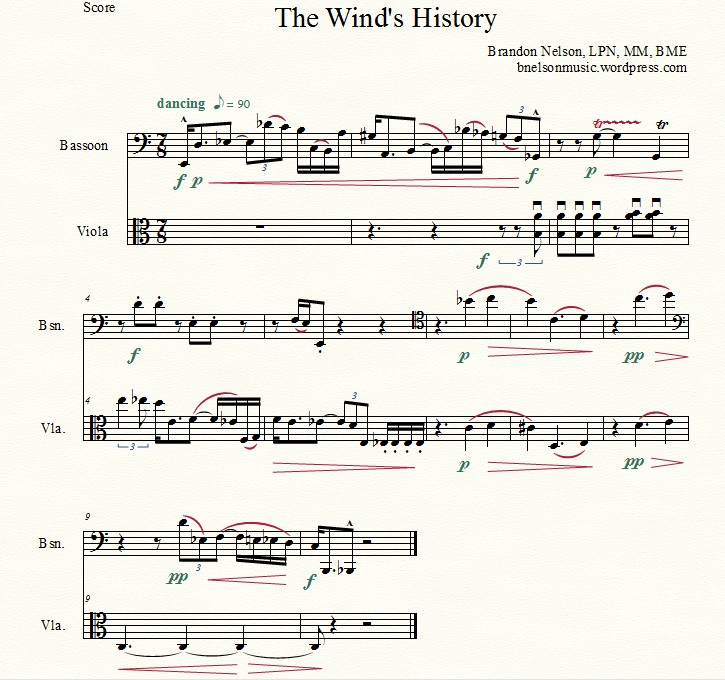
For this project (a short poem), I decide I want to explore the seventh. I will score it for bassoon and viola. I will use the major and minor 7th and I will allow myself use of the inversion, the major/minor 2nd. Use of any other intervals, I feel, would muddy the point of restricting intervals (though I could see using it merely as a jumping off point, should the muse strike, in larger projects). I could also decide that the 7th will dictate other parameters (phrasing in 7s, rhythmic units tied in some way to 7, etc.) but I choose to be freer in that regard.

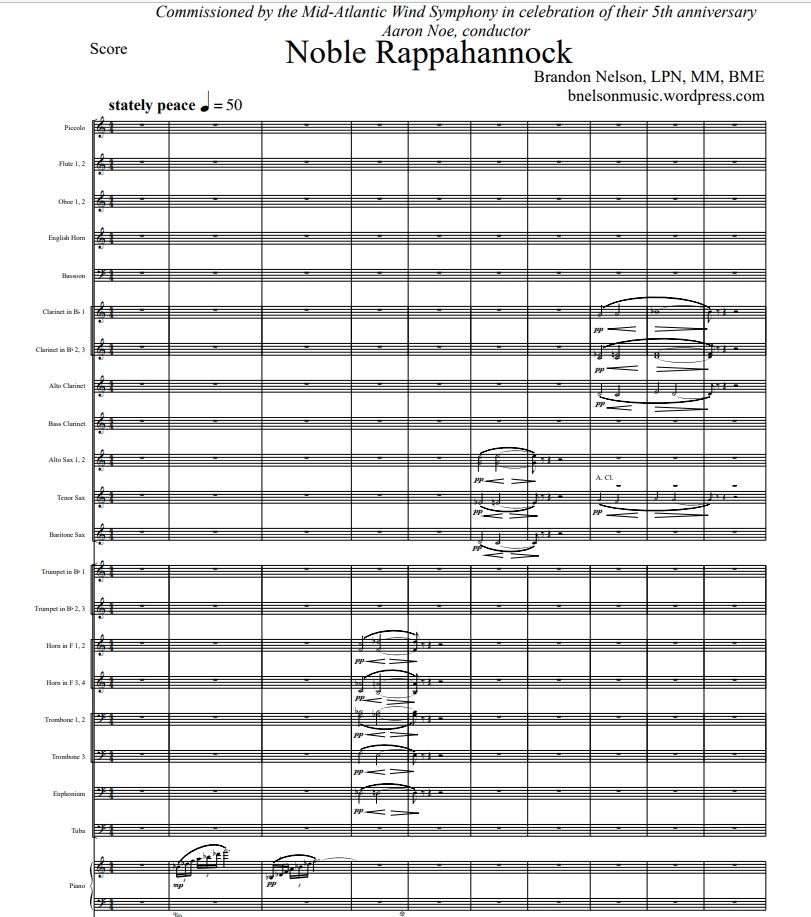
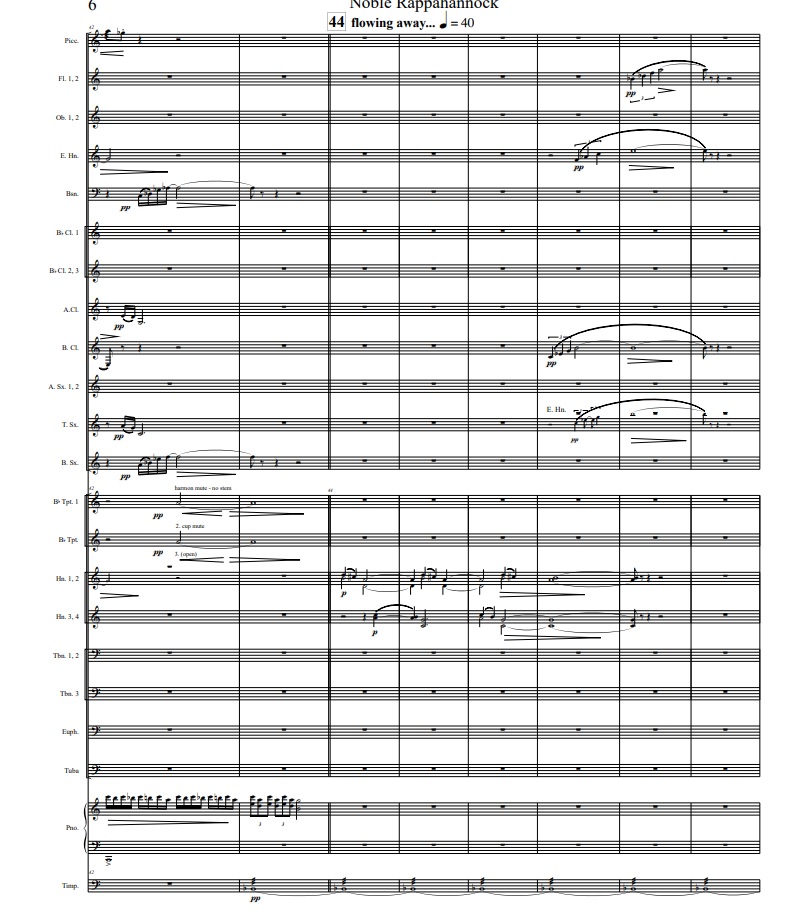
Commissioned to commemorate the fifth anniversary of the founding of the Mid-Atlantic
Wind Symphony, Noble Rappahannock is a poem for concert band. Just as the river, this
piece flows through stations stately and sentimental, large and intimate. The colors of the
ensemble paint impressions of not just this transcendental American landscape but of the
people and events that have helped shaped our course.


“PRN,” in this case, has numerous meanings. “P,” “R,” and “N” refer to types of harmonic progression within Hugo Riemann’s theoretical system. Starting from a given triad, “P” moves to the parallel major/minor triad, “R” goes to the relative major/minor triad, and “N,” if the previous chord was major goes to the minor subdominant and, if minor, goes to the major dominant. These relationships are exploited as the fundamental harmonic and melodic building blocks of the piece. Rhythmically, the “PRN” is regarded alphabetically. “P” is the 16th letter of the alphabet, “R” the 18th, and “N” the 14th letter. The distance from “P” to “R” is two letters and the distance from “R” to “N” is five letters. Taken with the difference between the two relationships (three), these are used to determine rhythm metric and proportional fashions. “PRN” also refers to the medical term “pro re nata,” or “take as needed.” As a nurse, PRN medications are a common encounter and serves in this case as a nod to my other professional vocation and my passion for healing.

Knowing that this piece was going to be performed by young students, I wanted to give
them the opportunity to share in the creative process of writing this piece. I had Mr. Ryan
Addair (the conductor of the group which commissioned the piece) ask each student in his
band class to come up with one word describing the experience of growing up in the 21st
century. I chose several representative examples from the list and depicted those thoughts
in music.
Each of the movements is based on the essential rhythmic gestures of the traditional
Baroque dance suite. I have used contemporary harmonies and other compositional
methods to give fresh perspective to these forms.
It is my hope that this suite will have special meaning to those performing it. I endeavored
to create a salient connection with both past and present while looking towards the future…


Commissioned by Dr. Philip Howie for the University of Cambridge Concert Band, Cambridge, UK.

Bringing together and celebrating both the storied past and bright future of music at Cambridge, this piece was commissioned to commemorate the 20th anniversary of the founding of the University of Cambridge Concert Band.
In researching the University for this piece, I found that Cambridge was the world’s first institution to confer a degree in music. A certain Henry Abyngdon received a Bachelor of Music in 1463, going on to serve as a well-respected church musician and composer for the rest of his life.
I was intending to use the work of Abyngdon as the basis for this piece, but I discovered that none of his music survives. Thus, I chose a work in the sacred idiom by Robert Fayrfax (Magnificat ‘Regale’), likely contemporaneous in style to the work Abyngdon would have written.
“Cambridge blue” is the official university color. I used that to imply the blues scale, which forms the pitch basis of this piece. The scale, however, is not generally used in its traditional sense but is instead explored from different angles, varying the order and harmonic presentation of the tones to create a distinctive, fresh sound that is, at its foundation, based in tradition.


 Brandon Nelson