• Fire, Flux, CHANGE! (unaccompanied tuba)

    In Light and In Shadow (trumpet and piano)

    Cardiac Rhythms (low brass trio – horn, trombone, tuba)

    Diptych (brass quintet)

    Dreamland (unaccompanied horn)

    Dusk Refrains Over Quincy Mine (solo trumpet with mixed sextet)

    Heroes of Snow and Ice (brass and percussion ensemble)

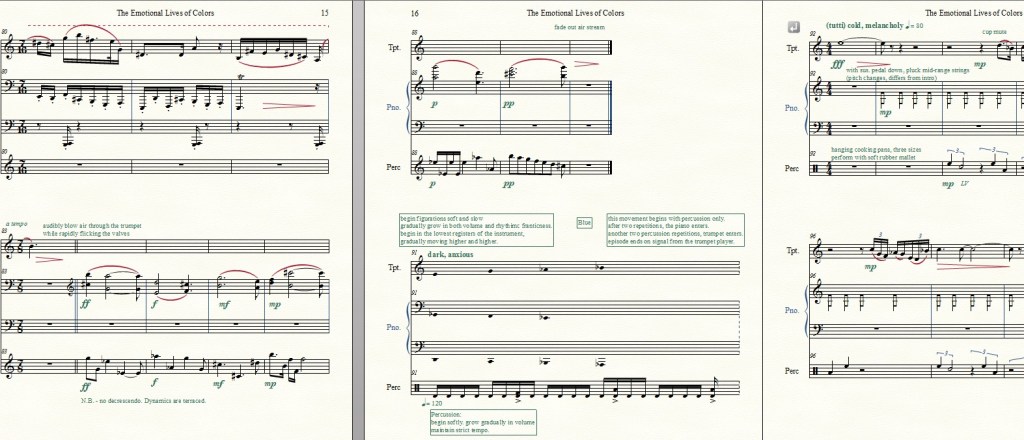
    The Emotional Lives of Colors (solo trumpet with piano and percussion)

    Favorite Hymns for Brass (brass quintet)

    Nyx (horn quintet)

    Postcards from Tunisia (horn duet)

  • Commissioned by Philippe Trovão (Lisbon, Portugal) 

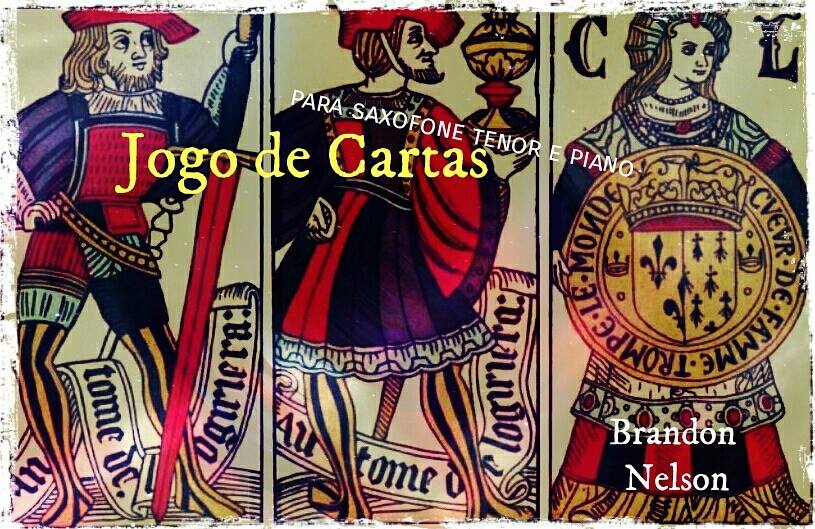
    Jogo de Cartes (tenor sax and piano)

    about the piece

    Jogo de Cartas is Portuguese for “card game.” I opted for the Portuguese to honor my patron for this piece, tenor saxophonist Philippe Trovão of Lisbon.

    In this work, I celebrate four favorite card games.

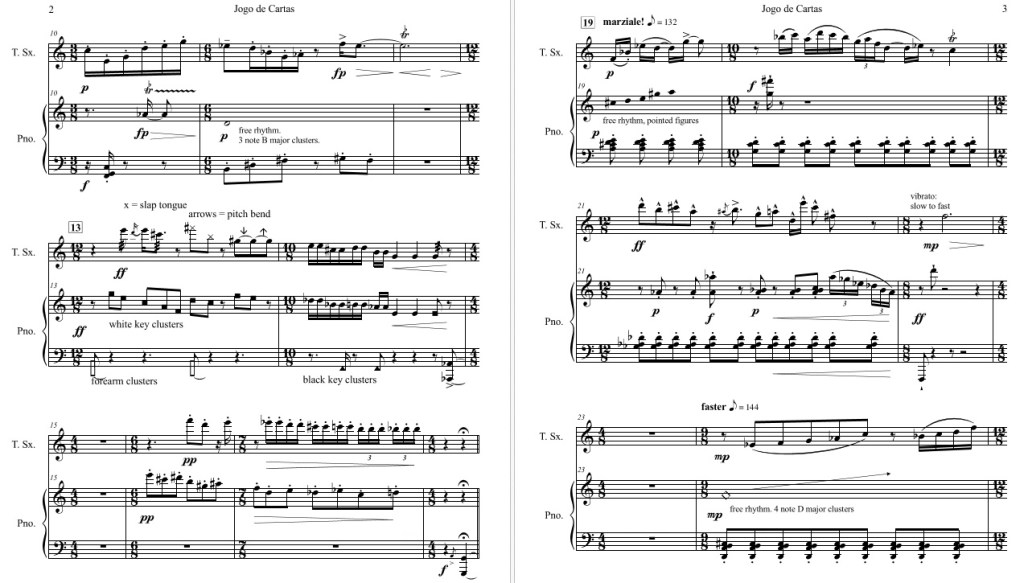
    War is a relatively simple game in which each player is dealt half of the deck. The players play one card and the player with the larger card value wins the “battle.” If both players play an identical value, a “war” is started. There are variations on the game at this point, but in one popular version, each player places three cards face down then play another card face up—whichever player has the highest card takes all the cards. The object is to win all of the cards in the deck. In this musical setting, the sax and piano are each a “player,” and each plays cards (translated into rhythmic values) with the conflict and victory painted in dynamic, sometimes dissonant vitality.

    In Solitaire, the sax plays alone as one plays this game alone. And, just as in the game, each phrase (or suit-based pile) becomes longer, more complex, and ends in an excited flurry of activity as “victory “ is achieved!

    The third movement, Blackjack, illustrates the deceptively-simple game of chance, with gradually ebbing and flowing tension until, in this case, the (sax) player takes the hand. The number 21 features prominently in the construction principles of the movement as a hand totaling 21 is considered the best in the game.

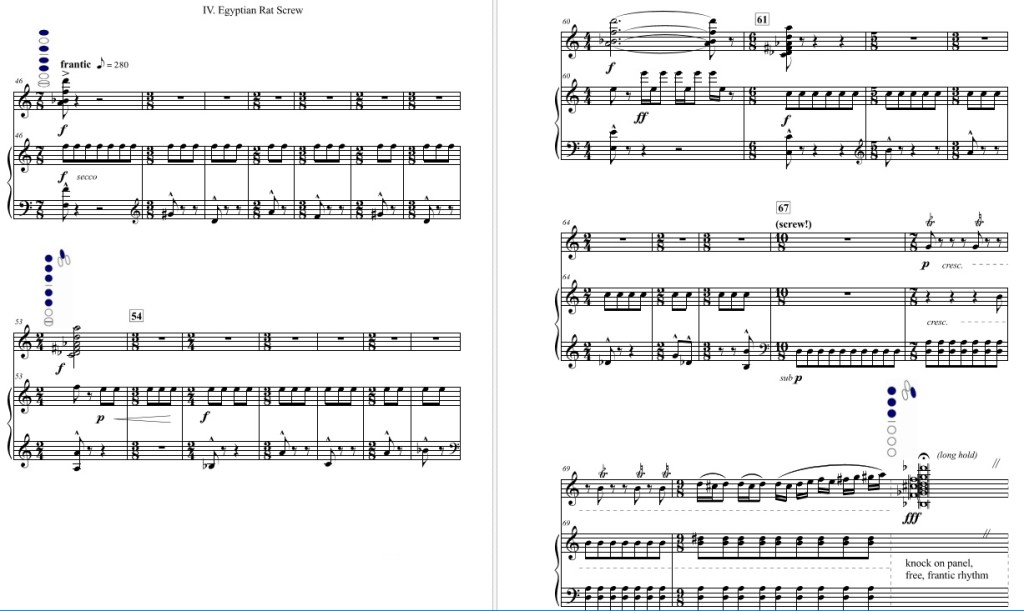
    The finale is a wild ride portraying a newer card game called Egyptian Rat Screw. In this colorful and fast-paced game, players flip one card up in turn, continuing to do so until one player puts down a face card. The next player then has several chances (based on the specific face card played) to match or beat that card. In a interesting quirk, if two players play cards of equal rank, the player who “slaps” the card pile first wins all of the cards in the pile. This unique game was fertile ground for musical interplay, illustrating both the back-and-forth and the more aggressive aspects of play!

    Jogo de Cartas (tenor sax and piano) - snapshot preview 1
    Snapshot Preview 1
    Jogo de Cartas (tenor sax and piano) - snapshot preview 2
    Snapshot Preview 2
    Jogo de Cartas (tenor sax and piano) - snapshot preview 3
    Snapshot Preview 3
  • commissioned by Marion Garver (San Diego, CA)

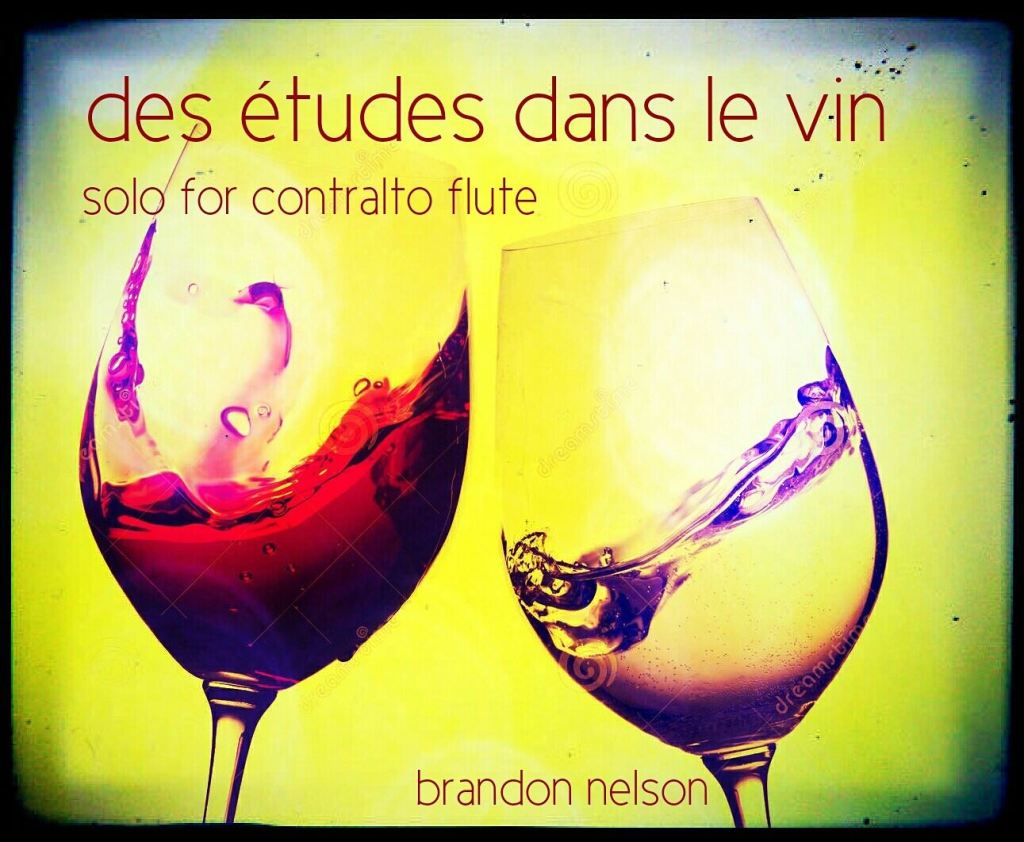
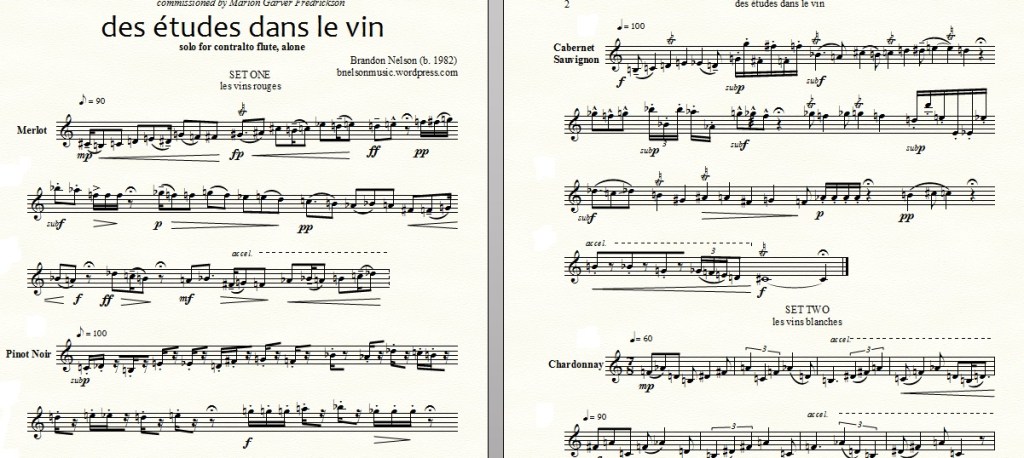
    des etudes dans le vin - solo for contralto flute

    In celebration of what are perhaps among the greatest gifts to the human palate, I composed this set of characteristic etudes based on several distinguished wines of France. Wine is beyond simply a beverage—it is a form of art in itself, elevated by centuries of refinement, and those of France in particular have been recognized by many as some of the finest specimens crafted.

    Set One” is devoted to red wines.

    Merlot, with scents of black cherry and plum, is a soft, well-rounded wine that makes an excellent introduction for those new to red wines (and an old favorite for the initiated).

    The essence of Pinot Noir is delicate and fresh. These grapes are difficult to grow, rarely blended, yet yield no roughness.

    The grande dame of French reds, Cabernet Sauvignon is full-bodied, firm, and gripping.

    The second set illustrates white wines.

    One of the most popular wines in the word, Chardonnay is velvety and voluptuous, with bold citrus notes.

    Sauvignon Blanc reveals a wide palate of subtle flavors, granting the sensitive imbiber delicate hints of bell pepper, sour green fruits, apples, pears, and even tropical fruits.

    We finish with Semillon. Noted for its great strength of berry flavoring, it is often blended to delimit its strong character.

    snapshot preview - des etudes dans le vin

     snapshot preview

  • 1462762697526

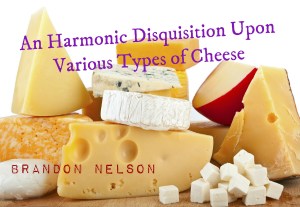
    Through characteristic miniatures, this piece is an aural sampler of some of the world’s most
    interesting cheeses (and the folk music of the people who produce them). Though my
    passion for cheese is well in evidence, I like to point out that my love for the piccolo runs just
    as strong, and I have sought with this piece to contribute a lively and colorful homage to the
    chamber repertoire of this sweet, agile instrument.

    -Feta
    Greek in origin, this is a crumbly aged cheese made mostly from sheep’s milk. The flavor is
    commonly described as tangy and salty. In this movement, I use the ancient Epitaph of Seikilos
    melody to dance around the light crumbles in the other voices.

    -Moose Cheese
    A product of Sweden, this rates as one of the world’s most rare (and expensive) cheeses. The
    moose tend not to be cooperative and the most gentle care needs to be taken in the milking
    process. The tune for this movement is a specimen of the gånglåt repertoire titled
    Gärdebylåten. Gånglåt are traditional fiddle songs of Sweden, roughly translating as
    “walking tune.”

    -Wensleydale
    A supple, crumbly, moist texture with subtle acidic notes greets the palate in this cheese of
    Yorkshire in England. The flavor is well-suited to sweeter produce and is often paired with
    cranberries. The Yorkshire folk tune On Ilkla Moor Baht’At (Cranbrook) is featured here.
    (You were expecting something from Wallace and Gromit, weren’t you?)

    -Flower of Rajya
    Though cheese is not commonly found in parts of the world where dairy products are not
    prominent in the diet, we note this Yak-based cheese in the mountaintop nation of Nepal.
    The milk is heated and ripened in big copper vats, curdled, drained and molded into 10-12
    pound wheels. The cheese is dry-cured in Tibetan red salt, aged, then wrapped in scarves and
    packed in bamboo baskets. The music of this movement is inspired by the ancient folk
    rhythms and melodies of Newar musicians.

    -Mozzarella
    This mild, soft, supple cheese of Italy is famous the world over, most notably as a key
    constituent of pizza. Italy is as rich in musical tradition as it is in its gastronomic offerings,
    and I decided to take my cue from the music of southern Italian bagpipers.

    -Gouda
    The first mention of Gouda dates from 1184, making it one of the oldest recorded cheeses in
    the world still made today. Adding to the storied heritage of this Dutch treat is the manner in
    Sheet Music Plus Order 5748379685. 1 copy purchased by Brandon Nelson on Nov 7, 2022.
    which it was bought and sold. Teams consisting of the guild of cheese-porters, identified by
    differently colored straw hats, carried the farmers’ cheeses on barrows, which typically
    weighed about 160 kg. Buyers then sampled the cheeses and negotiated a price using a ritual
    system called handjeklap in which buyers and sellers clap each other’s hands and shout
    prices. Once a price was agreed, the porters would carry the cheese to the weighing house
    and complete the sale. We hear in this movement a recorder tune composed by Renaissance
    Dutch composer Jacob van Eyck accompanied by some lively “bartering” from members of
    the ensemble.

    -Roquefort
    Choosing a notable representative of the cheeses of France is quite a tall order—in fact, I left it
    to the crowds of social media to choose for me! Roquefort is one of the world’s best known
    blue cheeses. The cheese is white, tangy, crumbly and slightly moist, with distinctive veins of
    blue mold. It has characteristic odor and flavor with a notable taste of butyric acid; the blue
    veins provide a sharp tang. The overall flavor sensation begins slightly mild, then waxes
    sweet, then smoky, and fades to a salty finish. The cheese is aged in the Cambalou caves
    before they are ready to be sold. I found the last detail to be quite interesting and imagined a
    theme of Machaut (Chanson balladée) as if it were echoing around the walls of these caves.

    -Square Yellow Cheese-like Product
    Perhaps one of the more readily-identifiable and distinctive U.S. contributions to global
    cuisine is this waxy yellow square that melts so graciously on burgers (or whatever else one
    would like). Although not legally considered to be “cheese” in it’s own right, it is, rather, an
    amalgam of several cheeses thence dyed to produce its characteristic coloration. I felt using
    “Old MacDonald Had a Farm” as source material would be a good-natured rib at this
    whimsical American staple

    Get the music here!

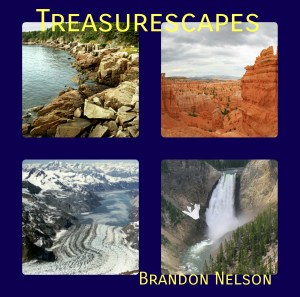
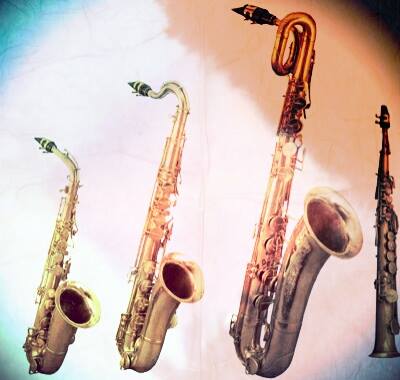
  • Inspired by the incredible beauty and majesty of America’s national parks, this suite captures the essence of four of these treasures, which belong to us all. Bryce Canyon, Yellowstone, Glacier Bay, and Acadia are all featured in this piece, scored for soprano sax, alto sax, tenor sax, and baritone sax. All players have engaging parts and only modest technical demands are made (intermediate level players will find this an appropriate challenge).

    Get the music here!

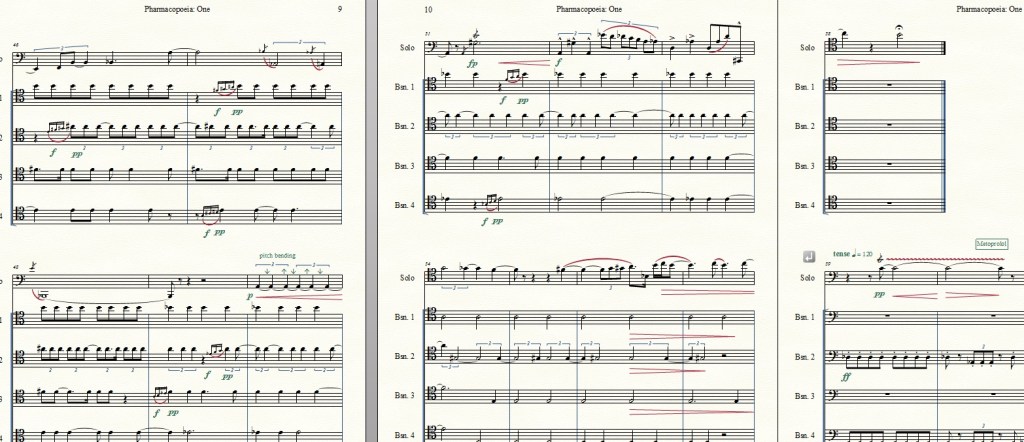
  • Commissioned by Jolene Masone (for solo bassoon with bassoon quartet)

    pharm

    About This Piece

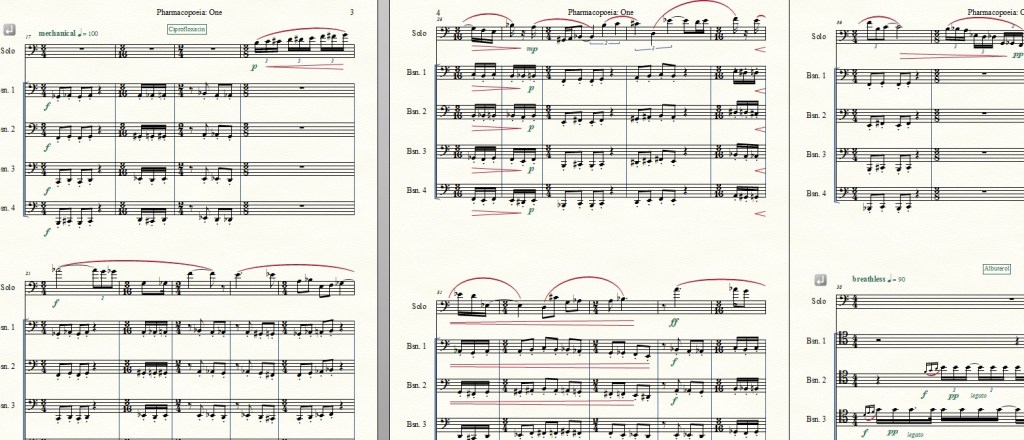
    In this piece (the first of an open-ended series of pieces), I explore four pharmaceutical agents, imagining how their effects on one’s body might be translated into sounds.

    The work opens with a prelude, which exhibits the primary melodic materials the rest of the piece is built upon.

    Ciprofloxacin is one of the most commonly prescribed antibiotics. I envision a “battle” between the drug and the offending bacterium, much as it occurs in the course of treating respiratory tract infections and urinary infections.

    In Albuterol, I begin the movement with rather “breathless” figures that gradually calm and end in wide open respite. Albuterol is best known for treating exacerbations of asthma, which relaxes bronchi that have become inflamed.

    When blood pressure becomes too high, this can cause a number of life-threatening conditions. One drug commonly used to bring blood pressure under control is Metoprolol, which acts on a number of bodily systems to “slow things down.” In this movement, I depict this gradual releasing of tension both in rhythmic figuration and in tempo.

    The final movement presents Modafinil, part of a relatively new class of drugs known as eugeroics. Essentially a stimulant, modafinil promotes wakefulness and is claimed by some to increase energy level and mental clarity. In this closing movement, I depict one of the less pleasant side effects of this stimulation: the jitters.

    Snapshot Preview 1
    Snapshot Preview 1
    Snapshot Preview 2
    Snapshot Preview 2
    Snapshot Preview 3
    Snapshot Preview 3
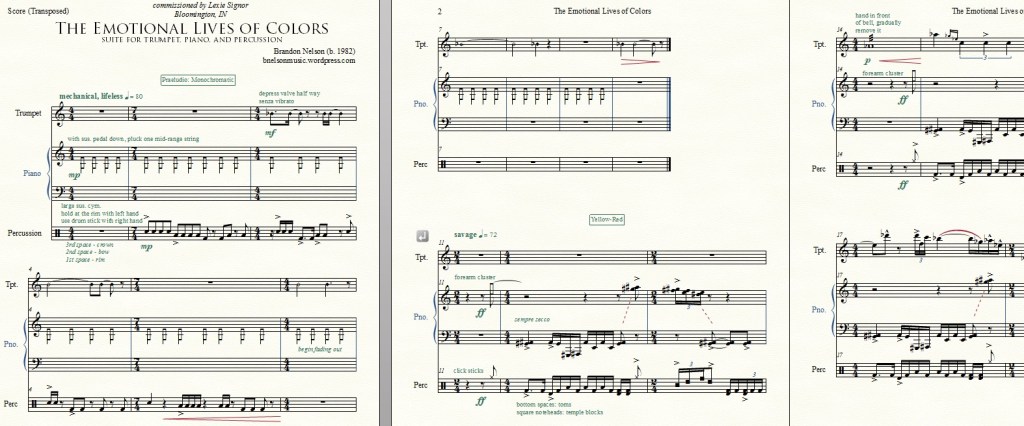
  • Commissioned by Lexie Signor (for trumpet, piano, and percussion)

    colours

    About This Piece

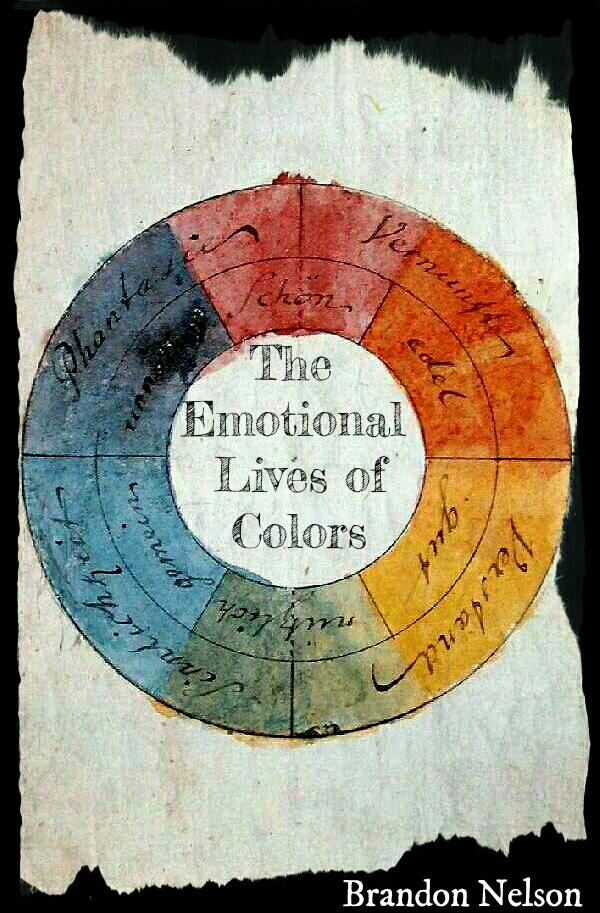
    Johann Wolfgang von Goethe and his theory on how colors impacted mental states was the inspiration for this piece. He was far more gifted with prose than I, so I’ll him explain further:

    We shall not be surprised to find that [colours’] effects are at all times decided and significant, and that they are immediately associated with the emotions of the mind.

    Colour, considered as an element of art, may be made subservient to the highest aesthetical needs.

    General impressions produced by single colours cannot be changed[.] They act specifically and must produce definite, specific states in the living organ. Experience teaches us that particular colours excite particular states of feeling.

    Goethe goes on to detail these notions in an elaborate, deeply imaginative treatise. Sadly for him, this work was coming out just as the science of optics had begun to give the world an empirical understanding of color, leaving Goethe’s romantic ideas in the margins.

    But it is those ideas that I find intriguing from a poetic viewpoint, and, in this composition, I shed musical light unto his dramatic descriptions of several different colors.

    “Yellow-Red” is described as “primordial, impetuous, robust,” to the point of eliciting “extreme excitement” which disturbs and enrages even animals!

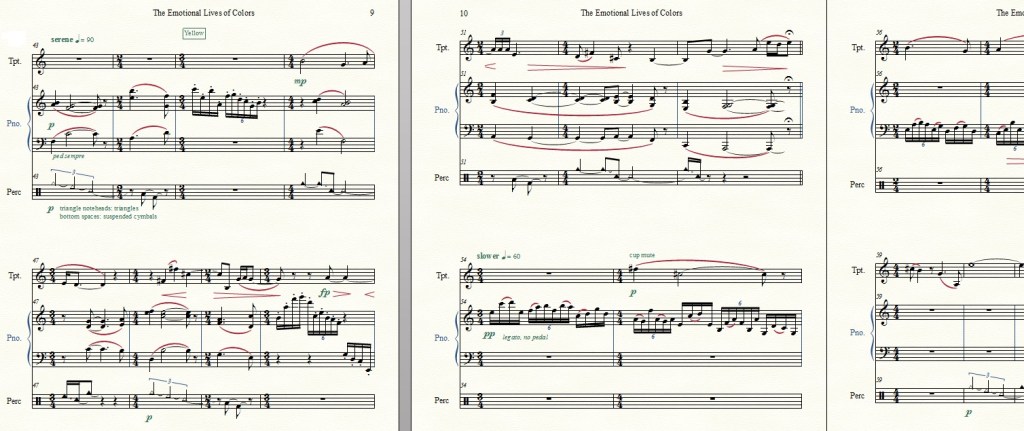
    “Yellow” is portrayed as that being nearest to natural light. It is of “utmost purity and beauty[….] Serene, gay, softly exciting.”

    The color “Red-Blue” we are told is “something lively without gladness.”

    “Blue” is steeped in darkness, a “contradiction between excitement and repose.” It gives one the “impression of cold.” and brings to mind melancholy.

    snapshot1
    Snapshot Preview 1
    snapshot2
    Snapshot Preview 2
    snapshot3
    Snapshot Preview 3
  • Scored for sax quartet (soprano, alto, tenor, baritone). Appropriate to any concert or recital setting. In mathematics, there exists a unique set of figures known as “transcendental numbers.” A transcendental number is a real or complex number that is not algebraic-that is, it is not a root of a non-zero polynomial equation with rational coefficients. These are rare because it is extremely difficult to prove that a number meets all the mentioned criteria. All transcendental numbers are irrational, since all rational numbers are algebraic. I find esoteric mathematical phenomena quite fascinating. One finds here that very tangible aspects of daily life are often described in ways that are quite complex and even confounding. There is an almost mystical magnetism to digging deeply into the universe around us. In this set of miniatures (four in all), I endeavor to find interesting ways to apply some of these transcendental numbers in music for saxophones.

    Miniature One: π

    “Pi” is the best known of the transcendent numbers. In this piece, I take the whole number of pi (3) and apply it formally (three sections, each divided into three sub-units, every third of which is distinct from the rest via articulation and dynamic level; three pulses of rest between each sub-unit; rhythmic expression determined through three different rhythmic bases). I took the first 45 decimal places of pi, divided them into units of 5 each, and applied the numerals to an aleatorically-determined basic rhythmic unit (16th note, eighth note, quarter note).The first section is in unison/octaves. The second explores pandiatonic harmony and the final makes use of the whole chromatic scale.

    Miniature Two: e

    The natural logarithm (abbreviated “e”) is of eminent importance in mathematics, alongside 0, 1, π and i. All five of these numbers play important and recurring roles across mathematics, and are the five constants appearing in one formulation of Euler’s identity. Like the constant π, e is irrational: it is not a ratio of integers. Also like π, e is transcendental: it is not a root of any non-zero polynomial with rational coefficients.I used the first 20 decimal places of e, divided into segments of five, then assigned each segment to a part. These numbers were used to determine the rhythmic values, with soprano and alto using an eighth note as a basis, and tenor and baritone using the quarter note. The leading whole number of e (2) I used to govern the overall formal structure (there are 2 cycles of each rhythmic pairing then ends with two cycles tutti).

    Miniature Three: Cahen’s Constant

    Cahen’s constant is an infinite series of unit fractions, with alternating signs. This constant is named after Eugène Cahen, who first formulated and investigated its series in 1891. It is notable as being one of a small number of naturally occurring transcendental numbers for which we know the complete continued fraction expansion.I took the first 12 decimal places and translated them into rhythmic durations, using the sixteenth note as the basic unit. I then took the sum of each pair of integers within the decimal places and assigned the output to chromatic pitches. The final episode features this rhythm in augmentation and using the previously-derived pitches as elements of seventh chords.

    Get the music here!

  • A set of intriguing, contrasting miniatures for unaccompanied viola. Aimed at higher level players, this piece is ideal for any concert or recital setting.

    The first in this set, “from darkness, rising,” is a lyric caprice which gradually moves from “darker” modes to “brighter” modes (locrian to lydian).

    The next selection, “Eidólons”, has a veiled, mysterious quality. In this piece, I explore variations based on rhythmic alteration. An “eidólon” is a spirit or phantasm; the term was a favorite of American poet Walt Whitman.

    The third entry, “Homeostatic”, is built upon a concept I refer to as “biofeedback music.” In this case, I took regularly-spaced readings of my pulse rate and blood oxygen saturation percentage and performed basic arithmetic operations on these figures, the results of which I used to determine a number of musical facets (most notably the essential constituents of the rhythmic gestures).

    The final piece, “Sapta Bodhyanga,” I built on a “wedge” concept (in this case, seven intervals, each becoming larger, ending with the octave). The number seven also features prominently in the design of the rhythmic motives (with chance procedures used in the deployment of these figures). Given the concentration on this number and the use of aleatoric methods, I titled this piece after the Zen Buddhist concept sapta-bodhyang, or seven degrees of enlightenment.

    Get the music here!