In the midst of the Baroque, Johann Fux found himself in a troubling position. He was a composer in a time when conventions of music were vague and composers were regarded as expendable. That is why he took it upon himself to write a treatise on the craft of composition, for he felt that if something was not done, music would devolve into a meaningless mishmash of fads. As he writes in the forward to his seminal work Gradus ad Parnassum:
Perhaps some will wonder at my undertaking to write about music, when there are at hand the opinions of so many excellent men who have written learnedly and sufficiently about it, and particularly at my doing so at a time when Music has become an almost arbitrary matter, and composers will no longer be bound by laws and rules, but avoid the names of School and Law as they would Death itself…
Fux, in this treatise, was almost certainly reacting against the complexities of the new instrumental music and the abandonment of the contrapuntal principles set forth by Palestrina.
It is for similar purposes that Paul Hindemith, nearly two centuries later, would publish his own compositional treatise. His life as a composer and educator would prove to be a struggle against what he saw to be a similar degradation of the craft of music. But was his legacy to music just as important as that of Johann Fux in saving music from near-sighted “revolutionaries”?
Hindemith’s career as a teacher was defined by his philosophical viewpoints on music in general. He believed first and foremost that music must be understood as a means of communication between the composer and the audience. Abstract music, he held, was not viable because it held value only to its composer. Hindemith felt that it was the composer’s responsibility to ascertain the needs and desires of the audience and to gratify them to the best of his ability.
With the intent of narrowing the gap between composer and amateur performer, Hindemith wrote some music specifically for amateurs, like Spielmusik (1927) and Sing und Spielmusiken fur Liebhaber und Musikfreunde (Vocal and instrumental music for amateurs and music-lovers; 1930). This music was to be performed for enjoyment, for fun, and for play. Somehow, the word gebrauchsmusik (music for use)—a term Hindemith despised—became associated with works of this kind.
Hindemith’s philosophy also encompassed more theoretical matters, and in fact he wrote a series of books on that subject, beginning in 1937 with The Craft of Musical Composition. The first book (out of three) puts forward in great detail Hindemith’s theories on the nature and organization of sound. In it, he makes the case for tonally-based works, and in particular, the great importance of the major triad as a unifying element:
Music, as long as it exists, will always take its departure from the major triad and return to it. The musician cannot escape it any more than the painter his primary colors or the architect his three dimensions. In composition, the triad or its direct extensions can never be avoided for more than a short time without completely confusing the listener. If the whim of an architect should produce a building in which all those parts which are normally vertical and horizontal (the floors, the walls, the ceiling) were at an oblique angle, a visitor would not tarry long in this perhaps “interesting” but useless structure. It is the force of gravity, and no will of ours, that makes us adjust ourselves horizontally and vertically. In the world of tones, the triad corresponds to the force of gravity. It serves as our constant guiding point, our unit of measure, and our goal, even in those sections of compositions which avoid it.
To support his assertions that music is essentially “lost” without a tonal center, he argues that the overtone series, a naturally-occurring acoustical phenomena which does indeed generate the major triad among its first (and most powerful) tones, ultimately governs all music and, therefore, can never truly be separated from it.
Hindemith even goes so far as to dispute the very existence of “atonality:
We have seen that tonal relations are founded in Nature, in the characteristics of sounding materials and of the ear, as well as in the pure relations of abstract numerical groups. We cannot escape the relationship of tones. Whenever two tones sound, either simultaneously or successively, they create a certain interval-value; whenever chords or intervals are connected, they enter into a more or less close relationship. And whenever the relationships of tones are played off one against another, tonal coherence appears. Tonality is a natural force, like gravity. Indeed, when we consider that the root of a chord, because of its most favorable vibration-ratio to the other tones, and the lowest tone of the chord, because of the actually greater dimension and weight of its wave, have greater importance than the other tones, we recognize at once that it is gravitation itself that draws the tones towards their roots and towards the bass line, and that relates a multiplicity of chords to the strongest among them. If we omit from consideration the widely held notion that everything in which the ear and the understanding are not at once completely at home is atonal (a poor excuse for a lack of musical training and for following the path of least resistance), we may assert that there are but two kinds of music: good music, in which tonal relations are handled intelligently and skillfully, and bad music, which disregards them and consequently mixes them in aimless fashion.
Clearly, then, Hindemith and his theories were anathema to the new wave of trends in modern music, atonality being chief among them. It is interesting to note, however, that even Arnold Schoenberg, the patriarch of serialism, admitted to the powerful gravitational influence of the overtone series in his own treatise, Theory of Harmony. It is evidence, perhaps, of the rapidly growing pluralism that was taking place in the first half of the twentieth century between those that held tightly to tonality (the Neo-Classicists, among them Hindemith) and those that thought abandonment of said tonality was not only theoretically possible, but an absolute artistic necessity.
Most likely, it is exactly that atmosphere of pluralism which provoked Hindemith into writing his books (and perhaps similar circumstances that inspired Fux to write his). Thus, Hindemith saw himself not just as a practicing composer, but as someone charged by destiny to bring order to a chaos-filled world. However, that his work enjoyed the same influence as Fux’s is doubtful. Most of his contemporaries disregarded his theories and even Hindemith himself was not always able to employ his own theories without significant exceptions.
Could Hindemith have realistically, all by himself, turned the artistic tide in music? It is dubious at best. Not only was music being effected by radical changes of attitudes and approaches, but so were the other arts. Increasingly, tonality and objectivism in general were seen as “old hat”—too worn out to be of any use to the “serious” composer.
In the end, what can be said of Paul Hindemith? That his music is of lasting value has already been demonstrated–his works continue to be studied and performed today. Will his theoretical works, however, come to be viewed more seriously by a wider spectrum of composers? Will Hindemith be our Fux? Or have we become so accustomed to the open-ended styles of our time that such ideas will only apply to a narrow band of aesthetic interests? Indeed, does our music even need “saving”?
Keep up with my work and join the community conversation on my Facebook page!
Today, we think of Ludwig van Beethoven’s nine symphonies as masterpieces. But this mentality was not as widespread when these works were first performed nearly 200 years ago. Indeed, the critics of the time generally panned Beethoven’s symphonies, sometimes rather harshly.
Beethoven composed his First Symphony in 1800 and premiered it the same year on April 2nd. Criticism of this symphony was quite unfavorable on its first performances. Leading critics of the time, including Joseph Preindl, the Abbé Stadler, and Dionys Weber, were quite upset by the fact that the introduction to the first movement began with what was then considered a “discord.” Another critic described the work as “a caricature of Haydn pushed to absurdity.” Some years later, however, the reviewers had reversed their position on this work and even Carl Maria von Weber, one of the severest critics of Beethoven’s symphonies, spoke highly of it.
I may be a bit obsessed with classroom management because, well, I used to be really bad at it. Most of my teacher training took good discipline for granted so when I stepped out in to the world for myself, I got quite a rude awakening. In a frenzied search for answers, I read literally dozens of books and articles and used my own classrooms as living laboratories to try out this or that method. Most failed miserably. Too complex, too arbitrary, too wishy-washy…nothing seemed quite right.
Going into my third year of teaching, I finally hit on an epiphany: keep it simple. Direct, concrete communication and modeling are far superior (and easier to handle on a day-to-day basis) than laundry lists of policies and consequences and elaborate “behavior modification” systems.
The findings and methods that follow are, in a nutshell, what I found works best, not only in terms of getting what I needed from students, but in terms of “managing” my classroom in a simple, effective manner.
***
Most kids who misbehave in class aren’t inherently malicious. They are “testing.” They wonder if the rules you talk about and the rules you will enforce are really the same thing. They are seeing if you can be trusted at your word. Students will not respect adults they can’t even trust to do a basic thing like provide secure and fair boundaries.
Kids are concrete, hands-on learners. In providing reinforcement of your boundaries, an endless series of “warnings” or “dirty looks” or stern lectures don’t DO anything and are thus not very effective. They need more than words in order to understand. They need to have those words coupled with confirming experiences; i.e., what HAPPENS if those rules aren’t respected. The following methods will resolve most problem behaviors.
Drake, an eighth grader, is playing his trombone while his band teacher is trying to give important instructions to the class.
Teacher: Drake, it’s against our rules to interrupt while I’m addressing the class. If you continue to do so, you will have to pack up and sit by yourself for the rest of the hour.
Drake: Fine. (he stops, but a minute later, starts up again)
Teacher: Drake, you need to pack up and sit here now.
Drake: What?! No fair! I never have time to practice my part!
Teacher: We are not discussing this right now. You made a choice. Please pack up and move to this seat. (Drake complies, albeit grudgingly. After class, the teacher takes Drake aside and explains that, while he’s a valued member of the band, he needs to respect the rules if he wants to continue his participation).
Drake was reminded of the rule and, at the same time, given a CHOICE: comply or face a consequence. When Drake chose not to comply, he was immediately given the consequence. And the teacher did not let Drake argue his way out and engage in a public power struggle. Not only does this teach Drake the correct behavior, but it serves as a concrete example to the rest of the class about the interruption policy. It’s important to note also that the teacher remained calm and assertive throughout. The teacher is not attacking the student but correcting a problem behavior.
METHOD 2: PROMPT FOR SELF-REMINDING
Gretchen, a fifth grader, was asked to clean up around her seat before leaving class but she is trying leave without doing it.
Teacher: Gretchen, what did I ask you to do? (The prompt)
Gretchen: Clean up around my seat? (Student indicates understanding)
Teacher: Yes. Please do so or you won’t be ready to leave. (Confirmation and a choice)
WHEN OUTSIDE HELP IS NEEDED
Most problems can and should be handled by the teacher. Constantly sending kids to the principal’s office not only irritates the principal (and demonstrates some evident professional weakness on your part), but it’s only teaching your students that somebody else has to solve the problems in your room. You are not teaching them to respect you. However, there are some instances where solving the problem yourself may not be preferable or possible. In cases of extreme defiance and/or violence, requesting assistance from administrators is certainly not unreasonable.
Communicating regularly with a child’s parents is always a good idea, especially when there have been problems with their child in your classroom. Having an ally at home is a valuable asset for any teacher and parents generally appreciate knowing what’s happening with their children and want to help. However, try to avoid only calling with something negative to report; an occasional call home about something positive enhances your rapport with the parent and doesn’t train them to be afraid to answer the phone when “school” comes up on the caller ID.
***
What I’ve detailed above can be a highly effective approach, but there are no “silver bullets” for classroom management. Flexibility is required here and I suggest that, in addition to these methods, you search out teachers who seem particularly impactful and effective and pick their brains. “Stealing” ideas here is not weak or wrong but a good way to hone your own approach.
Effective discipline is a valuable and necessary skill if any learning is to take place in your classroom. No child can be expected to learn much in an environment that is unfair, chaotic, or overly punitive. Finding the right balance for your classroom environment is key and the concepts in this article (gleaned from years of positive and negative experiences) provides a sound basis for that journey.
Music education seems to live in a perpetual state of conflict and controversy. Educators have for decades been barraged with questions about the educational value of music and whether it is prudent, in lean fiscal times, to spend tax dollars on a supposedly frivolous subject. Even those within the field seem at times beset with doubts—they treat their subject as if their critics’ characterizations were true.
This situation can seem hopeless. However, if conscientious music educators dedicated to the premise that what they do is truly important in the lives of students, can develop a clear, concise, coherent philosophical basis for what they do, a secure persuasive fortress can be constructed for times when critics attack.
The purpose of this article is to present such a philosophical basis for music education in the public schools. Music itself will be explored from its fundamental aesthetic level, then, upon this, specific educational conceits will be explored.
Fundamental Principles: On the Value of Music and of Music Education
Human beings can survive without art. Lungs will continue to breathe without poetry. Hearts will continue to pump without music. Neurons will continue to fire without painting. However, living means more than simply existing. Human kind is distinguished from the lower life forms by its propensity to create, to forge unique cultures. Purely objective, empirical, rational pursuits are important in building and perpetuating society, but what can life be without a means to express what cannot be expressed in hard fact alone? The creative mind is the mind that solves problems and truly innovates. Indeed, the world of man would be a cold, sterile, primitive place were it not for the arts.
Music has a great communicative power which other means cannot convey. Thus one of the most important reasons for music education is to pass on to students this communicative force. Enriching the ability of students to show what is in their hearts and minds, to change the world with inflections not possible any other way, is why we educate students in music. To deprive them of this would be to stunt our students’ emotional and intellectual growth.
Because of music’s inherent communicative and social properties, music educators should embrace full classroom integration. All students, even those with learning disabilities, can grow emotionally and enhance their appreciation of music in a well-taught music class sensitive to the needs of all students.
It is sometimes argued by well-meaning music educators that music makes students smarter in other subjects and helps them on standardized tests. There is, however, no proven link between music and these supposed benefits. We should not rely on defending our profession based on byproducts that don’t exist. This will only serve to weaken music education by making it subservient to other subjects instead of being equal, where it belongs. Only when music is recognized as being a serious subject with serious academic and artistic qualities of its own will it become more immune to the budget cutter’s axe.
On General Music Curricula
Music is both academic and artistic. This is borne out in the wealth of knowledge generated by theorists and philosophers as well as in the contributions of composers and performers. Therefore the focus of general music education—that which usually takes place at the elementary level and in higher level music appreciation courses—should not emphasize one facet over the other. Neglecting the academic for the artistic, as often happens, gives students—and parents and administrators—the wrong impression about the fullness of the musical experience.
The ultimate purpose of the elementary music course should be to lay the foundation for future study in music. This end can be achieved by augmenting the typical curricular emphasis on singing with basic instrumental performance. With such resources as Orff percussion instruments and widely-available recorders, students can be taught, and teachers can reinforce, such basic concepts as beat and rhythm and more complex concepts as improvisation.
In addition, basic theoretical knowledge should not be neglected. By the time a student completes the elementary music courses, he or she should, in the least, be able to read standard music notation. In addition to, and complimenting, this theoretical base should be composition training. Students can be guided through simple exercises growing out of improvisation until, by the end of their elementary training, they are able to notate their creations for others to perform. Composition is a vital component of any music education curriculum, one which truly embodies the personal creative spirit, and young children should not be denied it.
Singing, though it is quite common in the elementary curriculum, is often inadequate as preparatory study in music. Students should be taught to match pitch, to sightsing with solfege syllables, and should be taught proper breath control and posture for producing a pleasing tone. These elements are critical in order for students to gain sufficient knowledge of the art of performance so that, in turn, they can express themselves more clearly.
In music appreciation courses for older students, more theory and composition should be integrated. Too often these courses become dry lectures in history and this approach fails to connect students with the full power of the musical experience.
Music is about exploring one’s creativity in the world of sounds. Students, both elementary and older, should have ample opportunities to realize these possibilities—not just through performance, but also through composition and improvisation—instead of as an afterthought or, worse, not at all.
On Performance Curricula
Most students in middle and high school have the opportunity to enroll in a large performance ensemble. School bands, choirs, and orchestras flourish around the country. For many students, the performance ensemble is the only music course available. Thus it is critical that music educators involved in such courses take advantage of the opportunity they have to reach their students with a meaningful musical experience.
Students enrolled in a performance ensemble should have access to models of professional tone and style from the beginning and should continue to be exposed as much as possible throughout their education. Educators could provide recordings, invite guest musicians from the community, and mandate or encourage private lessons. Students need to hear what their instruments optimally sound like so that they have a clear goal for themselves. Without models, students will not progress far.
By the time a student finishes a complete course in instrumental performance, he or she should be able to, at minimum, play all major and minor scales from memory, be able to sightread a simple piece of music, and be able to play in tune with idiomatic tone. Choral students should, at minimum, be able to sightsing basic melodies with solfege syllables and be able to sing with a pleasing tone. These curricular benchmarks, if met, will give students the technique they need to fully express themselves as musicians and be prepared, if they choose, to enter collegiate music study.
Ultimately, no performance student should be subject to low standards from their educator. While it may seem easier in the short term to cut corners, it is the students—and the ensembles—that suffer if they are not pushed to higher levels of performance.
On the Integration of Non-Performance Curricula
As stated above, performance classes may be the only music courses available to many students. Music educators should take advantage of this fact to include the academic aspects of music to augment a rigorous performance curriculum. Topics for integration include music history, theory, and composition.
In order for students to gain a full appreciation of the richness of the musical experience, they should be exposed to the heritage of the music they are performing. Lecture need not be the only means to do this. Some ways to get students directly involved in exploring history could be small group projects, listening assignments, performing quality arrangements of period music, and creative writing assignments designed to get students to synthesize their knowledge of history with what they are presently performing.
Music theory helps to build students’ confidence in performance by helping them to understand what they are playing or singing, which, in turn, builds greater independence in making interpretive, creative decisions. Theory training need not take up large amounts of class time—simple theory concepts can be linked to daily performance issues. Teachers can discuss how scales are constructed before they are played, they can discuss formal construction when discussing phrasing, and the basics of harmony can be discussed in conjunction with almost any other ensemble issue.
Composition is the culmination of all other aspects of musical experience. It is the synthesis of art and academics. It is the apex of personal musical expression. Thus, a curriculum without composition is truly incomplete. A strong theory background is not essential to developing the creative potential of students in a performance class. Teachers can give students a basic framework for composition, beginning with short, simple pieces written for their own instruments. Such details as meter, motives, and pitch vocabulary can be given by the teacher so as not to overwhelm the students in the beginning. From these roots, teachers can continue to build into longer, more complex pieces. Ultimately, near the end of their performance course experience, students could write full ensemble pieces for performance by their peers.
Non-performance curricula is an essential part of any musical training. Because most students will only have access to performance courses, teachers need to integrate these aspects of music into their courses to give their students the full expressive palette of music.
Conclusion
Music education is a vital component of the public school experience. From this article a philosophical framework has been presented which can serve not only to defend music education’s rightful place in the curriculum but to bolster existing music education standards. All students should have access to a quality music education, and that includes a general music education program at the elementary level which prepares them for future study and performance courses designed to give them a balanced portrait of what music can be.
Music is an integral part of humanity. Every culture from the dawn of time has had at least a rudimentary form of music. To say that what we teach is frivolous and expendable is to deny millennia of human culture and its inherent expressive values. Students must be given the opportunity to realize their freedom to create as humans and teachers must be prepared to enable that freedom.
Keep up with my work and join the community conversation on my Facebook page!
Let’s face it: as musicians, we are walking small businesses. Our success hinges largely on our ability to get our names out and to turn positive attention into sales. Unfortunately, most of us lack any formal training in this area and are forced to flounder around, hoping to “get lucky” someday (I have long held that collegiate music schools should require their composition and performance students to pass a battery of business and marketing courses–after all, what good is learning to be a great musician if you don’t know how to sell yourself in a crowded marketplace?).
That said, there is a triad of fundamental marketing concepts that will help you to focus your efforts:
Product (Is your music interesting and well-crafted? Does it appeal to a reasonably wide audience?)
Pricing (Is your music priced appropriately given the market and your relative brand strength?)
Promotion (Are you aiming your advertising at the right audience? How well do you understand their needs and their purchasing behavior? Are you making effective use out of promotional engines? How well-connected are you in the music community?)
For composers, a sense of “newness” can often be obtained by digging into the past for raw materials. Felix Mendelssohn, for example, looked back to the Baroque period and, in particular, to the music of J.S. Bach for inspiration. Josquin de Prez, Giovanni da Palestrina, and other composers of the Renaissance frequently used Gregorian chant melodies as the basis for original compositions. Many composers today couch materials from the past to present a new perspective on those ideas.
The music of the earliest Christian churches, particularly in the years before AD 590 (when Pope Gregory was installed), is a body of work that, it seems, is not particularly well-known or exploited as a compositional resource. This pre-Gregorian literature is replete with musical materials useful for creative manipulation by composers, as it can be used to evoke a time, place, and feeling that has not widely reached the public ear in nearly two millennia.
The purpose of this article is to make composers aware of this ancient repertory so that they may include it among their creative resources. This survey will begin with an overview of the Greek musical traditions that were to have important influences on early Christian music. Later, the music of Judea is examined to give cultural context and additional technical features that would be assimilated into early Church music.
The Greek Influence
Ancient Greek music resembled that of the early Church in three fundamental ways. First, Greek music was primarily monophonic, that is, melody without harmony or counterpoint. Second, Greek music was almost entirely improvisational. Third, Greek music was always associated with words or dancing or both. Its melody and rhythm were intimately linked to the melody and rhythm of poetry, and the music of the religious drama, in which singers moved to prescribed dance patterns.
However, to say that the music of the early Church resembled Greek music in being monophonic, improvised, and inseparable from a text is not to assert a historical continuity. It was the theory rather than the practice of the ancient Greeks that affected the music of the early Church. Those theories were of two classes: doctrines of the nature of music, its place in the cosmos, its effects, and its proper uses in human society, and systematic descriptions of materials and patterns of musical composition. It is the latter theoretical body that will be explored here.
The musical theory of the Greeks contained five topics that were relevant to the early Christian repertoire: notes, intervals, genera, scale construction, and tonoi. The concepts of note and interval are dependent upon a distinction between two kinds of movement of the human voice: the continuous, in which the voice changes pitch in a constant gliding up and down without fixing on a pitch, and the diasematic, in which pitches are sustained and discrete distances, called intervals, are perceptible between them. Intervals such as tones, semitones, and ditones were combined into scales. The principal building block of the octave scale was the tetrachord, made up of four notes spanning a diatessaron or fourth. The fourth was one of three primary intervals—the others being the octave and the fifth—that were identified as being consonant.
Tetrachords were classified into three classes, or genera: the diatonic, the chromatic, and the enharmonic (Fig. 1). The highest and lowest pitches of these tetrachords were considered the most stable.
Fig. 1. Three genera of Ancient Greek tetrachords
Within the tetrachord, the lowest interval was normally the smallest, the highest interval the largest. Specifically, in the diatonic tetrachord the two top intervals were whole tones and the bottom one a semitone. In the chromatic tetrachord the top interval was a semiditone, or minor third, and the two lower intervals were semitones, or minor seconds. In the enharmonic tetrachord the top interval was a ditone, or major third, and the bottom two intervals were smaller than semitones, close to or actual quarter tones. Thus, tones such as B# and C were not identical in Greek theory. The modern piano produces such tones as identical pitches. Wind and brass players can lip the tones to differentiate the enharmonic tones, and string players can adjust fingers to achieve them.
Tetrachords were combined to form scale patterns. This joining might be disjunct, with the lowest note of one tetrachord being placed just above the highest note of the other, or conjunct, with the lowest note of the upper tetrachord being identical with the highest note of the lower tetrachord. Two of the diatonic tetrachords joined disjunctly formed a diatonic octave, or diatonic scale, which became the most commonly-used variety of scale formation.
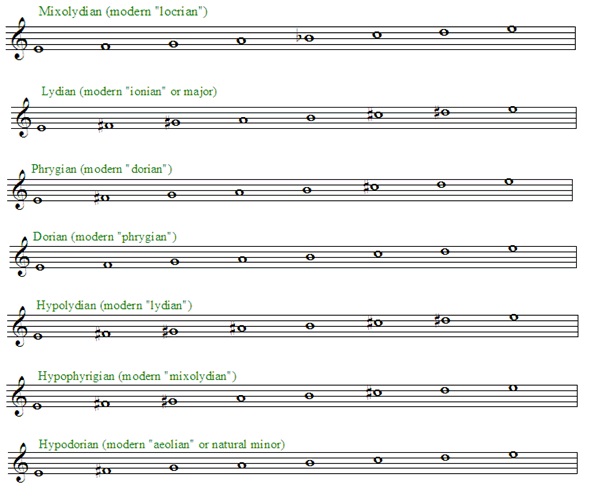
The modes, or tonoi, on which much of Greek music, and ultimately Jewish and Christian music, was built, differ from our modern naming system of modes. Both names are given in Fig. 2.
Fig. 2. Ancient Greek modes (with modern names)
A prime example of Ancient Greek music that is contemporaneous with early Christian music is the Epitaph of Seikilos (Fig. 3), which dates from the first century AD.
Fig. 3. Epitaph of Seikilos
Every note in the octave e-e’, with F and C sharped, is in this song, thus it is clearly identifiable as being in the Phrygian mode—dorian in modern nomenclature. The most prominent note is A; it is the most frequent note, and three of the four phrases begin on A. E is the topmost pitch in all four phrases, occurs six times, and is the final note of the piece. Of subsidiary importance are G, which closes two of the phrases but is skipped over at the end, and D, which closes one phrase. The major thirds would be perceived today, and probably then also, as bright, as would the rising fifth of the opening.
The repetition of the A is significant, as Greek music theory considered the tone in the middle of the scale—the mese—to be of principle importance in melodic construction. In the Problems attributed to Aristotle, it is stated: “in all good music mese occurs frequently, and all good composers have frequent recourse to mese, and, if they leave it, they soon return to it, as they do to no other note.”
The elements of music just explored in the Seikilos example also appear in the music of the Jews and Christians. The Ancient Greeks provided other cultures, contemporaneous and future, with certain fundamental ideas about music: a conception of music as consisting essentially of pure, unencumbered melodic line; the idea of melody intimately linked with words, especially in matters of rhythm and meter; a tradition of musical performance based essentially on improvisation within communally accepted conventions and making use of certain traditional melodic formulas; a scientifically founded acoustical theory; a system of scale formulation based on tetrachords; and a musical terminology. Part of this heritage, particularly the latter three listed, was specifically Greek; the rest was common to most if not all of the ancient world, including Israel and its environs.
The Judean Heritage
The Temple—that is, the second Temple of Jerusalem, which existed on the site of the original Temple of Solomon from 539 BC until its destruction by the Romans in 70 AD—was a place where public worship took place. That worship consisted mainly of a sacrifice, usually of a lamb, performed by priests, assisted by Levites, and witnessed by lay Israelite citizens. In the course of the sacrifice, a choir consisting of at least twelve Levites sang a psalm that was accompanied by string instruments. On important festivals, such as the eve of Passover, Psalms 113 to 118, which have Alleluia refrains, were sung while people made their personal sacrifices, and then a wind instrument perhaps resembling a modern oboe joined the string accompaniment.
There are obvious parallels between the Temple sacrifice and the Christian Mass. The Christian Mass was a symbolic sacrifice in which the priest partook of the blood in the form of wine, and the worshipers joined in partaking of the body of Christ in the form of bread. But insofar as the Mass is also a commemoration of the Last Supper, it imitates the festive Jewish meal, such as the ceremonial Passover meal, which was accompanied by music in the form of Psalm singing.
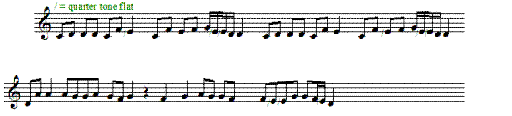
The music of the Temple, and later the music of the Church, was constructed in a manner very similar to the Greek tradition described above. Rhythm was intimately tied to the text, and melodies were constructed in a loose, improvisational manner. As important as the Greek contributions were, however, local contributions must also be considered to get a complete picture of musical style. Perhaps the most significant were that the Greek modes were sometimes altered by quarter tones and that the concept of mese, where the tone in the middle of the scale dominated the song, was mostly disregarded. For example, the following example (Fig. 4), an Arabic folk tune, shares many things in common with the Phrygian mode—modern dorian—except for the pitch E, which is consistently lowered by a quarter tone.
Fig. 4. An Arabic folk tune.
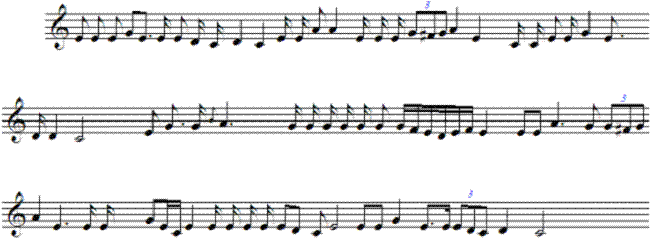
Also in Fig. 5 is seen the free, improvisational rhythmic quality so common to music of this region. Here, as in all other Temple music and Greek music before it, the rhythm is derived from the text. Note also that the pitches F and F# are both used frequently, hinting at, but never confirming, both the Greek modes Lydian and Hypolydian—modern Ionian and Lydian.
Fig. 5. An Ashkenazic worship song
Early Christian Liturgy
Some features of the music of Greece and Judea, as explored above, were surely absorbed into the Christian Church during its first two or three centuries. But certain aspects of ancient musical life were definitely rejected by the Church. One was the idea of cultivating music purely for enjoyment as art. Above all, the forms and types of music connected with the great public spectacles such as festivals, competitions, and dramatic performances were regarded as unsuitable for the Church, not so much from any dislike of music itself as from the need to wean the increasing numbers of converts away from everything associated with their pagan past. This attitude led at first to a distrust of all instrumental music. However, the Church reluctantly continued to give vocal music a place of increasing importance because its values to the Church were believed to outweigh negative effects it might have—and it was popular with the people.
The oldest extant example of Christian hymnody was found in a large document known as the Oxyrhynchus papyrus, which dates from the third century AD. To say that this is an indication of all Christian music from this period is purely speculative, however, as no other examples have been found that would support this assertion.
The Oxyrhynchus hymn (Fig. 6) centers on C and all of the Bs are flat, thus it is in the Hypophrygian mode—mixolydian in the modern nomenclature. The rhythm, as in Greek and Judean songs, is free and based on a text.
Fig. 6. The Oxyrhynchus hymn.
That singing took a prominent role in early Christian worship is well-documented. For example, St. Augustine, an important philosopher of the early Church, wrote:
Then it was first instituted that after the manner of the Eastern churches, hymns and psalms should be sung lest the people should wax faint through the tediousness of sorrow: and from that day to this [this was written c. AD 400] the custom is retained, divers, yea, almost all Thy congregations, throughout other parts of the world, following herein.
And in the New Testament:
Let the gospel of Christ dwell among you in all its richness; teach and instruct one another with all the wisdom it gives you. With psalms and hymns and spiritual songs, sing from the heart in gratitude to God (Col 3:16).
As has been seen and documented, the music of the early Church was been based on Greek tradition. This is confirmed not only by the Oxyrhynchus papyrus but also by a number of paintings from sarcophagi which depict the use of Greek instruments in Christian musical worship. It is well-known that the Greeks used a series of modes in the construction of their melodies and that the text setting was largely based on the metric scheme and accent of the words. From this it is reasonable to assume that Christian music of this early period would have done the same.
Christian Music Expands
Beyond the influences of Greek and Judean traditions, the beginning of a unique musicality among Christendom began to take shape around the fifth century AD, when Christianity began to spread to different cultures. It is from the church established in Byzantium that perhaps the clearest and richest example of this expansion of the early Christian repertoire is evident.
Byzantium, or Constantinople, was the seat of the most powerful government in Europe and the center of a flourishing culture which blended Greek and Judean elements. Byzantine melodies are not composed in a key or mode but are composed using a certain group of formulas, called “echos” or modes. This seems to be the basic principle of musical composition in the Syro-Palestinian region, and it spread from there with the expansion of early Christian music to the countries of the Byzantine Empire and to those of the Mediterranean basin.
The character of Byzantine music was considerably modified by the language to which it was sung. The original form remained unaltered only in a few bilingual chants in which they original language survived as a relic. And, unlike in the old Greek and Jewish music, improvisation was a less accepted practice.
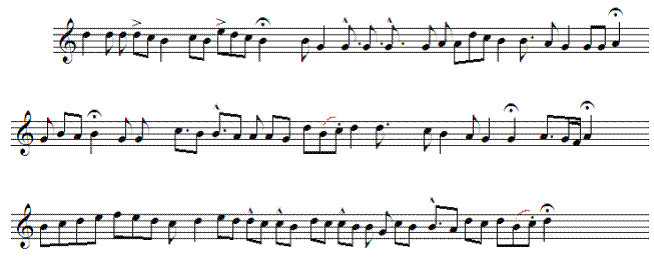
The following (Fig. 7) was composed by Ioannes Plousiadenos. This hymn features no chromatic alteration and focuses on the pitch D, thus it is in the Phrygian mode—modern dorian. It features marked accents within a non-metric scheme that compliments the text.
Fig. 7. Byzantine hymn on the text of John 14:9, 6:56
As the church continued to spread, more regional variants of early Church music began to crop up. The Franko-Roman type, which came to be known as Gregorian, after Pope Gregory, would soon supplant all others in a standardization of the church liturgy. Examples that still remain of other regional types show very few differences from the Gregorian chant literature.
Practical Considerations for the Composer
The music explored in this survey does not fit easily into modern metric schemes. This is an important consideration when choosing which ancient melodies to use in composition, and especially if writing for younger student musicians.
Language can be a problem when drawing from early Christian sources for setting. English translations of the texts can be problematic to find and, even if such translations can be found, it is unlikely that the translations will fit logically with the tunes, which were constructed to fit the original language. Also of concern is proper pronunciation of ancient texts. Pronunciation study in such languages as Aramaic, Hebrew, or Ancient Greek will be helpful for both the composer and performer.
Quarter tones, as has been seen, feature prominently in the melodic material of this ancient music. There is currently no standardized notation for quarter tones. The use of the / symbol—as seen in Fig. 4—is one possible notation. However the composer chooses to notate the quarter tone, a clear explanation should appear in the score and in the parts.
Professional musicians should have little difficulty producing quarter tones reliably. For student musicians, however, quarter tones should be used with caution. The younger musician will more reliably produce the quarter tone if it is approached and left from standard pitches in the modern chromatic scale.
Wind and string instruments are capable of producing quarter tones through manipulation of embouchure and finger position, respectively. Percussion and keyboard instruments should not have quarter tones written in their parts unless it is known that a specially-manufactured instrument is available.
Conclusion
Christian liturgical music, prior to the standardization of liturgical music by Pope Gregory, was both rich and unique from a modern standpoint. The music of this period embraced the knowledge of the Greeks and the folk traditions of Judea and eventually blossomed into its own style as Christianity spread to diverse cultures. Composers today now have at their disposal not only the abundant Gregorian repertoire, but examples and stylistic elements of the music that preceded it.
Get a downloadable version of this article, complete with sources cited and comprehensive bibliography here.
Keep up with my work and join the community conversation on my Facebook page!
Innovation is the key to artistic achievement. Indeed, the history of the arts can be seen as a continuous attempt at creative evolution—to forge something new in order to stir hearts and minds.
For more than a century, there has been a dualistic current running through the arts in regard to creating innovate works: Modernism and Postmodernism. Many of the attempts at creative evolution in this century and the previous have fallen into one or the other aesthetic mindset.
The purpose of today’s article is to explicate the conflict in the arts between modern and postmodern aesthetic philosophies. In addition, it will attempt to present clear definitions of Modernism and Postmodernism as being in relation to each other rather than as being mutually-exclusive philosophies.
Here’s how my income sources broke down last year:
The Day Gig: 57%
Composing (commissions, sales): 18%
Conducting: 23%
Performance: 2%
My “day gig” was working part time at a preschool. It was fun, interesting work and I even occasionally got to use some of my music training, but it hardly qualified as a “music job.”
So did I self-identify as a preschool classroom aide or as a musician?
One of the biggest challenges I found from my days as a school music teacher was making important concepts come to life and really be relevant to kids. Finding examples of these concepts in their pop music (with school-appropriate lyrics, of course) was one of the ways I found to make these vital connections and invite them to draw comparisons to the historical pieces and theoretical concepts that were the intended objectives.
I stumbled across a song recently that would fit the bill perfectly. Listen, and I want you to try to sing the bass line:
Did you catch it? What’s remarkable about this is the presence of the complete circle of fourths progression–from tonic to tonic with no divergences along the way. Sure, you’ll often hear circle of fourths progressions in limited deployment, but to use the whole thing is not all that common with today’s pop music.
Here’s the progression Ms. Gomez sings around:
C#m F#m B E A d#o G# C#m
or in Roman Numeral analysis:
i iv VII III VI iio V i
(Note the songwriters’ use of the subtonic instead of the leading tone and the major instead of augmented version of the mediant–not uncommon alterations but perhaps this has been consciously done to reflect the mood of the lyrics at those moments.)
On top of the theory stuff, you can also make the connection between Selena Gomez and Bach (along with many other Baroque and Classical composers), for whom this sort of extended progression was more stock-in-trade. You can play the historical music and they will grasp how, from a harmonic perspective, it has been put together.
Keep up with my work and join the community conversation on my Facebook page!
So you’re a bright young composer, your portfolio is brimming with intriguing new music, your brain is bursting with the knowledge and spirit to rock the music world…
…and very few people know you. And you’ve had very few, if any, sales or commissions.
How’d THAT happen? More importantly, what can prevent (or fix) that situation?
I was recently remarking to a very good friend and colleague of mine how my one regret about my grad school experience was not getting to know the conducting and music education majors better. Because it had occurred to me, after all my years of composing (with only scant success gaining exposure) that I simply didn’t know enough people who could help me.

 I may be a bit obsessed with classroom management because, well, I used to be really bad at it. Most of my teacher training took good discipline for granted so when I stepped out in to the world for myself, I got quite a rude awakening. In a frenzied search for answers, I read literally dozens of books and articles and used my own classrooms as living laboratories to try out this or that method. Most failed miserably. Too complex, too arbitrary, too wishy-washy…nothing seemed quite right.


 Brandon Nelson