• cover

    Imagine the terrifying prospect of having your fate-indeed, the fate of the entire universe-decided by the fickle whims of seven gods! This was life for all those who dwelled in the ancient society of Sumeria! They Who Decide Fate paints the picture of what living with these gods might have been like for those pitiable mortals. The introduction builds to the dreadful “fate” theme, which is woven within the rest of the piece.

    In the first episode, the Eb clarinet is highlighted depicting Enki, the magical, clever Lord of the Earth. Crafty and mischievous, one would not cross this god, so mighty he was said to have created the Tigris and Euphrates rivers between which the entire Sumerian world existed!

    The full orchestra comes roaring back to represent Shamash, the Lion of Justice. Bringing wrongdoers their just due, he could also be merciful, curing the faithful sick who plead for his mercy.

    The second episode is gently ushered in by the Basset horn. Featured here is Ninhursag, the mild, nurturing Mother Goddess. It was said that any couple who desired to be fertile would do well to propitiate themselves to her…

    An explosive, percussive jolt fanfares in Inanna, wild, untamed Goddess of Primal Passions! Whether in war or in lust, Inanna stood for all things raw-and ultimately destructive!

    The low, rumbling voice of the contralto clarinet brings us Anu, Father of the Gods. Ancient and wise, Anu is the manifestation of the heavenly vault.

    Nanna, the moon god riding on the back of a bull, illuminated the night sky. Sparkling and light colors of the orchestra depict his deft, spry nocturnal motions.

    The sinuous lines of the Bb clarinet illustrate Enlil, fickle God of Wind and Weather. It is said that it was he who created humans, but lost interest in them and flooded the whole earth.

    The whole clarinet quartet reprises the “fate” theme one last time, ending in an exultant flurry, reflecting both the fear and ecstasy that these seven gods inspired in their mortal charges.

    Get the music here!

  • Adolphic Vignettes (alto sax and piano)

    Commissioned to commemorate the 200th anniversary of Adophe Sax’s birth, each of the movements of this piece (beyond the expository prelude) presents miniature vignettes of music written in Belgium’s past as seen through the lens of Sax’s invention. It is, in that sense, an homage to not only the great musical minds that came before Sax, but also to his own keen inventive mind and incomparable contributions to music history. The Postlude involves a curious intersection of Sax with another brilliant musical mind: Richard Wagner. Sax was the stage director for a performance of Wagner’s Tannhauser, and he put some saxophones offstage with French horns because he couldn’t find enough horn players in Paris. Wagner was so angry he rescored the Shepherd’s Tune from Act 3 of Tristan und Isolde from saxophone to English horn. A portion of that tune appears in the Postlude to this piece, “rectifying” this petty bit of vengeance for Sax.

    Get the music here!

  • abramelin

    This work is based on the book by the same title. In it, one Abraham of Wurzburg, an aspiring medieval mage and devout Jew, describes a tour that he made of points in Europe and the Middle East, searching for a mentor who would not turn out to be a charlatan (or worse). Abraham eventually finds such a figure in a small town on the banks of the Nile. Here he meets the great magician Abramelin, whose system of magic Abraham sets out in detail. What results is the present volume, which puts forth a complete course in ceremonial magic (both white and black). In Abramelin’s system, after a lengthy period of self-purification and prayer, one may call upon one’s Holy Guardian Angel, who will then instruct one further on how to conjure up the princes and demons of Hell to do your bidding. The crux of this involves using certain special squares of anagrammatic words that would compel the conjured demon to perform specified tasks. In this piece, I take five of these squares and depict them in colorful, virtuosic tone paintings.

    Get the music here!

  • 2014

    Oh, what a year!

    For the first half of 2014, things were chugging along as they usually had in past years:  hit or miss opportunities, slow trickle of actual writing, plenty of self doubt.  But then, I came up with an idea that would electrify my career:  the free commission drawing.

    I literally came up with the concept in a few minutes one day in June.  Instead of trying to give away my already-written music for free (an idea which really hadn’t stirred much interest in any case), I figured why not offer to compose a new piece of music for one musician free of charge?  I would advertise the opportunity on social media and concurrently use the promotion as a vehicle for boosting my own social presence (you can read the original article for all the details on how it worked).

    Boy, was I unprepared for what was about to hit.  I was inundated with entries.   So many fantastic groups and individuals applied that I couldn’t let myself squander so many potential collaborations.  I decided to draw for 15 winners instead of one.  After a whirlwind month of getting to know musicians all around the world, I held the drawing on the first of August.  You can read the list of winners here.

    So not only did I greatly expand my social reach (one of the original goals of the project) but I now had a large of number of amazing musicians who wanted to perform and record my music.  My stage was (and still is) getting exponentially larger.  And the project has subsequently started to attract paying commissions.  I really couldn’t be happier about how this turned out.

    As of the New Year, I have written three of the FCD pieces (Novacane Quartet, Dr. Brian Kauth, Duo Rodinia), and composed two pieces for other, unrelated commissions (New England Flute Orchestra, International Low Brass Trio).  I am currently working on the composition for the University of Cambridge Concert Band (Cambridge, UK).  When finished, I will continue the whirlwind of writing straight through to December:  a selection for Ryan Addair‘s high school band in Virginia, a piece for Kevin Norton for soprano sax and piano, a work for Philippe Trovão for tenor sax and piano, a selection for Aaron Noe and his Mid Atlantic Wind Symphony, a piece for Lisa Hanson Bartholow and the woodwind quintet Peachtree Consort, a work for Chris Nadeau and his percussion duo CAn-Duo, a trio to feature Lexie Signor on trumpet, a piece for Celtic harp and flute for Chaski, a solo for vibraphone for Matthew Valenzuela, a work for Brian Wilson and his high school band in Wisconsin, and a selection featuring bassoon for Jolene Masone.

    This December, I had the first of the performances when the International Low Brass Trio performed my piece “Cardiac Rhythms.” This marked the first time my music was performed outside of the upper Midwest (as far as I know).

    There have been a few bittersweet developments.  As I graduated from nursing school in August, I started working full time in long term care.  This, in combination with the great increase in writing activity (and possibly preparing to got to med school), required me to step away from my performance commitments.  I had to say goodbye to the male chorus and the drum corps.  I will miss belonging to these great groups of people, but I will always have the wonderful memories and the many ways they helped shape my musicianship and leadership.

    I can’t tell you all how much I’m looking forward to 2015!  Many great musical moments to come!  Thanks for sticking around for the ride so far!


  • ilbt

    As both a composer and a nurse, I sometimes like to find ways to combine my passions for music and medicine. In this piece, I musically explore several of the significant heart rhythms encountered in patients. The primary motivic idea is a rhythmic phrase that is reshaped to reflect the idiosyncrasies of the heart rhythm being depicted. Sinus rhythm is considered the normal state of the healthy heart. Its beat is strong and regular. Atrial fibrillation is noted by an increase in heart rate and irregularity of rhythm. The beating becomes much less predictable. If left untreated, clots may form which can result in stroke, heart attack, and possibly death. Ventricular tachycardia causes the heart to beat very rapidly, with occasional rhythmic irregularities. It’s most commonly the result of electrolyte imbalances. In ventricular fibrillation, the heart beats so quickly that it begins to resemble a quivering mass of gelatin. The lower chambers of the heart can no longer perform their pumping function, which can lead to systemic shock. This is an emergency situation. Asystole is the absence of a heartbeat. Death is not far behind (or may have already occurred).

    Get the music here!

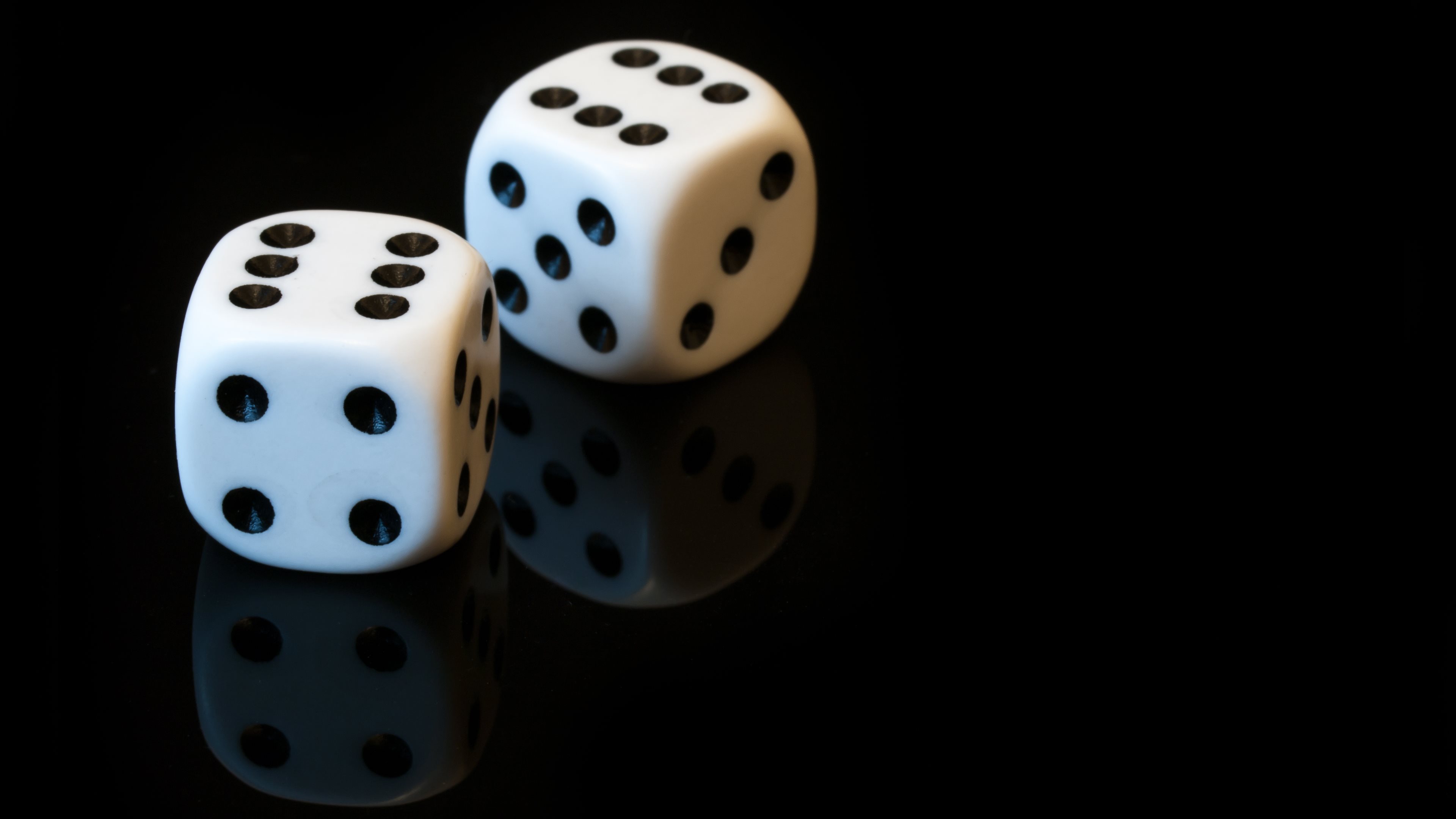
  • Pair of white dice on a black reflective background

    I’m sure by now we’re all pretty familiar with the idea of using dice (and other such devices) to make chance-based choices in composition.  I decided to see how far I could take this concept and I came up with the:

    FLEXIBLE INTEGRAL-ALEATORIC PRECOMPOSITIONAL ALGORITHM
    Within a Consonant Neotonal Framework (Optional)

    Whole-Piece Governors

    Note that any/all of these variables may be altered to suit your individual preferences.  What follows is just one way to “fill in the blanks.”

    After the medium has been determined by the composer (e.g., chamber orchestra, band, woodwind quintet, percussion ensemble, etc.) the following procedures are undertaken:

    The essential formal outlines of the piece are determined first. Using a standard pair of dice, roll to find the fundamental description:

    form

    Length of formal sections is determined by the composer.

    The general expressive character of the piece is next determined (this step is optional):

    character

    Rate of dynamic change:

    dynchange

    Determine now a discrete set of rhythmic data to be used throughout the piece (using the below-described process).

    Tempo:

    tempo

    Transitional tempo effects (e.g., ritard, accelerando, etc.) may be decided by the composer’s particular tastes.

    Unit Governors

    The underlying harmony is next. The root of the chord:

    roots

    The quality and voice composition (triad, etc.) of the chord:

    qualities

    Rate of harmonic change (the meter will be determined by the melodic data):

    change

    Harmonic data are deployed for all voices through the determined duration.

    The melodic data is gathered next. Whether chord members only are to be used or if the harmonic data is to be interpreted as scalar is determined by rolling the dice: even for the former and odd for the latter.

    Harmonic data is applied to melodic data through rhythmic predetermination:

    iterations

    The rhythmic unit having been determined, next to be determined is the number of iterations of said unit. Roll the pair of dice; the resultant number is the number of iterations.

    After the first bar rhythmic iterations have been determined, the hence-derived meter governs the following rhythmic iterations value for as long as the timbral grouping allows (i.e., the subsequent iterations value cannot violate the number of bars previously assigned to the timbral grouping). The subsequent bar(s), then, must be in the same meter to allow for the timbral grouping assignment. Thus, rhythmic iterations of the determined rhythmic unit have already been determined.
    For each iteration of the rhythmic unit, an articulation for it is assigned:

    articulation

    In the same way as rhythmic iteration, dynamics are assigned (this is optional and is largely dependent upon the level of difficulty intended by the composer):

    dynamics

    Transitional dynamic effects (e.g., crescendo, decrescendo, etc.) may be decided by the composer’s particular tastes.

    Texture (for the formal section, entire piece, or harmonic span):

    span

    Specific texture to be used:

    texture

    Timbral Grouping (length determined by composer taste):

    timbralgrouping

    Instruments involved in the timbral grouping (solo, small group) are determined by composer taste.

    SAMPLE COMPOSITION ILLUSTRATING THE PROCESS

    Whole-Piece Governors

    Medium: Violin duet

    Formal Outline: rolled a 10 (minuet-and-trio)

    It was determined by the composer that the minuet section would comprise 32 bars and the trio would compose 24 bars. Each section may be repeated at the performer’s discretion.

    General Expressive Character: rolled a 10 (idyllic/pastoral)

    Dynamic Rate of Change: rolled an 8 (freely determined)

    Since dynamics are to be freely determined, the Dynamic Assignment process is not needed for this piece.

    Tempo: rolled an 8 (allegro)

    Unit Governors

    Underlying Harmony: rolled a 10 (Gb)

    Quality and Voice Composition of the Chord: rolled a 12 (+M 7th)

    Chordal Manifestation: Gb-Bb-D-F
    Scalar Manifestation: Gb-Ab-Bb-C-D-Eb-F

    Rate of Harmonic Change: rolled a two (2/bar)

    Thus, a new underlying harmony will be determined halfway through this bar.

    Use of Harmonic Data: rolled an 8 (chordal manifestation only)

    Rhyhtmic Unit: rolled a 7 (dotted-eighth, 16th)

    Iterations of the Unit: rolled a 4 (four iterations)

    Four “dotted-eight, 16th” patterns will be used. The meter most obviously suggested by this would be 4/4.

    Therefore, the Gb+M7 harmonic unit will be used for the first two beats, and another harmonic unit will complete the measure.

    Underlying Harmony: rolled a 6 (D)

    Quality and Voice Composition of the Chord: rolled an 8 (mm7)

    Rate of Harmonic Change already determined (the latter half of the present measure)

    Use of Harmonic Data: rolled a 12 (chordal manifestation only)

    D-F-A-C

    Rhythmic Unit and Iterations of the Unit already determined.

    Assignment of Articulation:

    Eight rhythmic subunits must be determined, thus the dice must be rolled eight times (one articulation for each unit).

    Unit 1: rolled a 5(^)
    Unit 2: rolled a 9—must roll again; rolled a 6 (normal)
    Unit 3: rolled a 10—must roll again; rolled a 2( _ )
    Unit 4: rolled an 8—must roll again; rolled a 6 (normal)
    Unit 5: rolled a 7—must roll again; rolled a 6 (normal)
    Unit 6: rolled a 6 (normal)
    Unit 7: rolled a 3 (.)
    Unit 8: rolled a 2 ( _ )

    sample

    Textural Duration: rolled a 5 (entire piece)

    Textural Assignment: rolled a 2 (homophonic – chordal)

    Timbral Grouping: rolled a 7 (solo)

    In a medium as small as this, small group and tutti are regarded as the same.

    It was decided that this timbral grouping should last for two bars, after which a roll of the dice would be required to decide the next texture.
    Overall Plan of the Piece:

    plan

    Fun stuff!  What can YOU come up with?

  • I got pretty lucky with this concept.

    As you’re no doubt aware (since I flogged it all last month on social media), I decided to try a promotion where I’d hold a drawing for a free commission.  I thought I’d get maybe a few nibbles.

    Boy was I wrong.

    In fact, I had so much interest that I decided to draw for more than one winner. I’m very excited that I will have the opportunity to work with so many great performers (and to have my music heard in many more venues)!

    The new interactions have really  proven to be one of the highlights of this experience.  I’ve gotten to meet lots of great performers and learned much about them.  It was hard not to be able to pick them all!

    By random drawing, here are the 15 winners of free commissions. I will be developing an ambitious production schedule shortly and many more details will follow!  (Subscribe to my blog to keep up!)

    Dr. Brian Kauth

    Dr. Brian Kauth currently serves on the faculty of Borough of Manhattan Community College/CUNY in New York City, as well as maintaining an active private saxophone studio in the Hudson Valley. He has been a featured soloist with or member of many ensembles, including the City of Hattiesburg Concert Band, the USM Wind Ensemble, the Southern Mississippi Symphony Orchestra, the Greater Newburgh Symphony Orchestra, the New York Wind Symphony, and the Ridgewood Concert Band, in addition to being a regular performer at conferences of the North American Saxophone Alliance. A strong proponent of new music, Dr. Kauth has worked with several composers to foster the creation of new works for the saxophone, and is currently pursuing avenues to produce a recording of new works dedicated to him.

    Dr. Kauth will be commissioning a suite of miniatures for sax and piano.

    Mr. Brian Wilson

    Mr. Brian K. Wilson is Associate Director of Bands at Oshkosh West High School. At West he works with all aspects of one of Wisconsin’s largest band programs, co-teaching four concert bands, the Summer Marching Band, pep bands, and chamber ensembles totaling nearly 300 students. Brian strongly believes in the performance of new works. He has commissioned works of Rick Kirby, Charles Rochester Young, Nicolás Gutiérrez, and Elena Avalos-Bock, in addition to arranging music published through Jalen Publishing. In his spare time, Mr. Wilson enjoys traveling, technology, attending concerts and spending time with friends and family.

    Mr. Wilson will be commissioning a work to be written for his Varsity Band.

    Novacane Quartet

    Founded in January 2014 by Erik Franklin, the Novacane Quartet performs new music for clarinet quartet throughout the United States. A chief mission of the Novacane Quartet is to expand the repertoire for clarinet quartet through new music commissions by contemporary composers. In addition to performing new compositions, the Novacane Quartet seeks to perform classical music in a variety of ways, presenting concerts in special venues and collaborating with artists of various disciplines.   Members include Erik Franklin, Samantha Johnson, Kylie Stultz, and Keith Northover.

    Novacane will be commissioning a work for clarinet quartet and orchestra.

    Mr. Ken Pendergrass

    Unfortunately, Mr. Pendergrass has had to withdraw from the commission project due to unforeseen changes in his circumstances.  I hope to be able to work with him in the future!

    Mr. Ryan Addair

    Ryan Addair is the Director of Bands at Chancellor High School in Fredericksburg, Virginia.  He is a native of Virginia and he earned his Bachelor of Music Education degree from James Madison University.  His duties at Chancellor High School include directing the Symphonic Band, Concert Band, Jazz Ensemble, and Percussion Ensemble, and overseeing the Black Thunder Indoor Drumline and Stormfront Indoor Colorguard.  Ryan is also a co-sponsor of the Tri-M National Music Honor Society and the director of the award winning Lightning Regiment Marching Band.  During his tenure, the Chancellor Band program has earned several awards including Virginia Honor Band, Grand Champion and first place awards at several competitions, and superior ratings at both VBODA marching band and concert band assessments.  In addition, Chancellor High School’s music department has been a multiple recipient of the VMEA Blue Ribbon Award.  Prior to working at Chancellor, Ryan was the Director of Bands at James Monroe High School and Walker-Grant Middle School in the City of Fredericksburg for six years.

    Mr. Addair will be commissioning a piece for his symphonic band.

    Mr. Kevin Norton

    Kevin Norton is a saxophonist based out of Cincinnati, Ohio, and is currently a DMA Candidate at the University of Cincinnati College-Conservatory of Music, where he studies with Dr. James Bunte. In addition, he is a private saxophone instructor in the Cincinnati area (primarily at Walnut Hills High School), and, during the 2012-13 school year, he was an Adjunct Instructor at The Defiance College in Defiance, OH. Prior to CCM, Kevin earned a Bachelor’s degree in Music Education and a Master’s in Music from Morehead State University, where he studied with Dr. Nathan Nabb and Prof. Eugene Norden. Kevin has performed extensively, most notably at NASA biennials in 2008, 2010, 2012 and 2014, as well as regional conferences in Greensboro (NC), Chicago and Bowling Green (OH). His first album, Americano, is expected to be released in late 2014.

    Mr. Norton will be commissioning a piece for soprano sax and piano.

    Ms. Lisa Kachouee

    Lisa Kachouee is active as a chamber, solo, and orchestral clarinetist as well as a pedagogue. Within the past year she has performed recitals at Carnegie Hall, at 10 Universities, as a soloist with the Tallahassee Composer’s Orchestra, and with symphonies throughout the Southeast. She has recorded for Vox Novus and the Naxos label. She regularly gives master classes and is currently ABD at Florida State University. With composer and percussionist, Jamie Whitmarsh, Lisa is a member of Duo Rodinia. The ensemble, active since 2012, tours with new and adapted works and is committed to education and outreach. The 2014-1015 season will include the premieres of several commissioned works.

    Ms. Kachouee will be commissioning a piece for Bb clarinet and vibraphone.

    Mr. Aaron Noe

    Aaron Noe is the Conductor and Artistic Director of the Mid-Atlantic Wind Symphony (MAWS) and serves as the Director of Bands at Riverbend High School in Fredericksburg, VA. In addition to his roles as a conductor, Aaron Noe composes and arranges for Wind Band and maintains an active performance schedule as a classical and jazz trumpet player.

    The Mid-Atlantic Wind Symphony (MAWS) is an invitational wind orchestra comprised of professional musicians from the mid-atlantic region volunteering their time to promote wind band literature. MAWS is dedicated to the promotion of the finest classical band music through the performance of compositions by modern composers while respecting the rich heritage of the American Wind Ensemble as established by John Philip Sousa and his contemporaries.

    Mr. Noe will be commissioning a work for the MAWS in commemoration of their 5th anniversary.

    Mr. Chris Nadeau (CAn-Duo)

    CAn-Duo is a Dallas based percussion duo. Chris Nadeau and Anthony Jackson bring an eclectic blend of musical experiences from Orchestral Percussion, Drum Corps, Jazz, Rock, Brazilian, and Classical all together. CAn-Duo works to bring new literature to the percussion scene through original compositions, transcriptions, and commissions. As a duo, they have performed many events, including the Southern California International Marimba Competition, the North Texas Percussion Festival, and the UNT Keyboard Percussion Symposium. Individually, they have performed with many groups such as The Cavaliers Drum and Bugle Corps, Texarkana Symphony, Shreveport Symphony, South Arkansas Symphony, North-East Texas Symphony, and the Lone Star Wind Orchestra.

    Mr. Nadeau will be commissioning a piece for the percussion duo.

    Ms. Lisa Bartholow

    Lisa Bartholow is the flute instructor and flute choir director at Georgia College and State University, Toccoa Falls College, and Clayton State University where she has also taught music appreciation, woodwind chamber literature, and music business courses. She has played flute, piccolo, and baroque flute as a recitalist and with classical and popular ensembles in St. Louis, Chicago, and Atlanta ranging from chamber music to symphonic to back-up for pop artists. A devoted chamber musician, Lisa performs with an Atlanta-based woodwind quartet and quintet, and has appeared as a guest artist with the Chester String Quartet. Lisa also enjoys several ‘accidental’ careers in addition to music including that of stage technician and stage manager for both musical and theatrical productions, arts administration, and program note annotator.

    Ms. Bartholow will be commissioning a piece for woodwind quintet.

    Mr. Philippe Trovão

    Philippe Trovão is currently earning a Masters Degree in Education at Lisbon Music University and teaches in the Lisbon Music Conservatory. He has performed as a soloist with many ensembles and orchestras, including the Chieri Sinfonietta Orchestra, the Camerata de Sopros Silva Dionísio and the Lisbon Music University Symphony Orchestra. Despite his young age, he has been distinguished many times in competitions in Portugal and Italy.  He actively plays with big bands, contemporary ensembles, and wind bands, making him a versatile musician. He is also working with composers in order to expand the tenor saxophone repertoire.

    Mr. Trovão will be commissioning a piece for tenor sax and piano.

    Ms. Joelene Masone

    Jolene Masone is an active and engaging bassoonist based in North Texas. A devoted contemporary artist, Jolene is committed to playing and promoting new works for the bassoon, and bringing new pieces to the repertoire. She can be heard in recordings for the Lone Star Wind Orchestra, the REvolution Contemporary Collective, and North Texas Wind Symphony. Jolene has attended the University of Northern Colorado, Peabody Conservatory, and the University of North Texas.

    Ms. Masone will be commissioning a piece featuring bassoon.

    Ms. Shana Norton

    Shana Norton graduated with highest honors earning a Bachelor of Music Education from Abilene Christian
    University and attended the Eastman School of Music, studying with Julia Hermann Edwards and Eileen Malone. She is a founding member of the acclaimed flute/harp duo, Chaski. She plays principal harp with the Mid-Texas Symphony and the Symphony of the Hills. Ms. Norton has performed with the San Antonio Symphony, the Hot Springs Music Festival Orchestra, the Victoria Bach Festival Orchestra and the Corpus Christi Symphony Orchestra. She is a member of the Bouldin Creek Bobkat Band; bluegrass/western swing group, Diminished 7; Beatles tribute band, #9 Orchestra; and is a frequent guest with 1,001 Nights, middle eastern ensemble.

    Ms. Norton will be commissioning a piece for her flute/harp duo, Chaski.

    Dr. Philip Howie

    Philip is a regular percussionist based in Cambridge, UK, performing with the likes of the City of Cambridge Symphony Orchestra, Sinfonia of Cambridge and Cambridge Symphonic Winds among many others. He is also a conductor with a special interest in wind band music, and has been conductor of the University of Cambridge Concert Band for eight years and their Musical Director for five. In this time he has premiered a number of new works for the ensemble, including one of his own compositions. Despite all the best distractions afforded by the Cambridge musical scene, he has nonetheless managed to complete a PhD in materials science and now carries out post-doctoral research into the mechanical properties of ceramic and crystalline materials.

    Dr. Howie will be commissioning a work for the University of Cambridge Concert Band, to commemorate their founding in October 1994.

    Mr. Matthew Valenzuela

    Matthew Valenzuela is a freelance percussionist and music educator based in the Eugene, OR, area. He is currently studying towards a Master’s degree in Percussion Performance at the University of Oregon, studying under Pius Cheung. He recently performed in solo recital at the Brookings-Harbor Friends of Music Young Artists concert, in which he was named winner of the instrumental division. He has performed in master classes with Nancy Zeltsman, Jack Van Geem, and has performed alongside master percussionists Anders Astrand and Javier Nandayapa in concert at the Zeltsman Marimba Festival. He is a proud member of Phi Mu Alpha Sinfonia Fraternity and the Percussive Arts Society.

    Mr. Valenzuela will be commissioning a solo work for vibraphone.

    Congratulations to all the winners and I look forward to working with you all!

  • brandon copyHello, artists and ensembles!

    During the month of July, I’m running a unique promotion:  I’ll be holding a drawing for free commissioned pieces!

    For more on me:

    • I invite you to read my bio on my welcome page.
    • Learn more about my professional composition background (including past and current commissions) on my CV.
    • Sample some of my work here.

    The Rules  – * UPDATED 7/19/14 *

    (all of which you implicitly agree to by entering this promotion)

    All entrants must be of at least 18 years of age by the beginning of this promotion (July 1, 2014).

    There are no residency requirements, though English language will be used exclusively.

    This promotion applies only to Facebook and Twitter.

    You may participate on both Facebook and Twitter (please note specific rules below) and entries will be aggregated from both networks.

    Multiple entries are possible and encouraged.

    I will begin counting entries as of the initial post time of this article on either network.

    Facebook rules:

    • You must first “like” my page
    • You must like the article post.  Since I will be posting this article multiple times over the month, each time you like said post counts as one drawing entry.
    • You must leave a comment on the post this article appears on (and it will be posted several times over the month).  Each time you comment counts as one drawing entry.
    • Sharing this article to your own wall is encouraged, though, by Facebook’s own rules, I cannot count shares as drawing entries.

    Twitter rules:

    • You must first follow my account.
    • You get a drawing entry every time you retweet a tweet of mine that includes a link to this article (I’ll be using the hashtag #FreeCommission to help you out)
    • One time per day, you may create your own tweet linking to this article to receive a drawing entry.  The tweet must include a working link, it must include my twitter handle (@brandonjnelson), my handle must not appear at the beginning of the tweet (otherwise only our mutual followers and I will be able to see it), and it must include some meaningful text indicating what the link is about (e.g., just tweeting a hyperlink and my handle won’t count).

    The commissioned piece will range between 3-5 minutes in length.

    You must publicly perform the commissioned piece no later than one year after delivery of said piece.  (You must provide me with a program from said performance, either PDF or via mail).

    You must provide a recording of the commissioned piece (either YouTube video or audio file).

    There are no restrictions on the size of the ensemble (i.e., individual artist through full orchestra).

    I do not work in the medium of electronic music.

    All other aspects of the commission (e.g., style, form, title, etc.) may be negotiated between me and the winning parties.

    This promotion ends at 11:59pm EST on July 31, 2014.  No entries will be accepted after that time.

    On August 1st, 2014,  I will conduct a drawing for several winners (the final number of winners is solely my decision). I will make three good faith attempts (over the course of three days) to contact the winners.  If these attempts are not successful, I will draw for entrants to take the place(s) of those not able to be contacted and will do so until contactable winner(s) is/are selected.

    I will publicly announce the winner on both Facebook and Twitter.

    I will transmit a commissioning contract to each winner, in essence outlining the terms already listed here.   If the winner does not sign said contract within one week of delivery, another winner will be drawn to take their place.

    Good luck, everyone!  

  • kafkaI don’t remember ever “becoming” a composer. I’ve always felt the inner push to write down musical ideas and it’s an impulse I’ve always been happy to follow. It’s always seemed logical and natural to me, then, to invest the better part of my life in pursuit of the profession.  My young adulthood was spent getting two degrees in music in addition to the countless hours on my own spent pouring over scores, listening to recordings, perfecting drafts, begging for reading sessions, working with publishers and patrons, and all the other difficult but necessary things young composers do to hone their craft and build their careers. It’s a pursuit I doggedly continue into the present.

    Yet, especially in light of troubling economic times, I sometimes wonder if it wouldn’t  be more sensible to cast this all aside and pick up an additional job instead.  The question brings itself into sharp focus:  why compose?

    Read the rest of this (and much more) in my book Writing and Living in the Real World: Advice for Young Composers

  • R (1)

    I was lurking around one of the composers’ groups on Facebook recently, when I saw that someone had posted about the omnibus progression.  It piqued my attention.  The term sounded like one I’d come across in my studies, but I’d gotten hazy on the particulars.  So, as I normally do when I come across a shiny new musical object, I dropped everything I was doing (probably just homework or child rearing or something) and launched into a Quest for Knowledge.

    I found an omnibus progression is one which could, in theory, go on forever without coming to a resolution.   It’s characterized by chromatic lines (usually in the outer voices) moving in opposite directions.  Over the course of this continuous mutation, dominant seventh chords occasionally result, at which points the composer could opt to stop the progression and modulate.  Thus, an omnibus progression could be used as an elaborate dominant prolongation or as a novel way to achieve modulation.

    Here’s a simple example to illustrate:

    A traditional omnibus progression
    A traditional omnibus progression (source: en.wikipedia.org/wiki/Omnibus_progrression)

    The bass voice descends by half steps while the soprano voice gradually climbs by half steps.  On the last beat of the first measure, a G7 chord results, and the composer opts to use it to bring the phrase back to tonic.

    I think that’s pretty interesting–simple, elegant, economical, useful.

    Like most composers, I like to play around with things and figure out how to make them my own.  So I thought, instead of using this in a tonal context, what would happen if the basic principles were applied to “freer” harmonies?

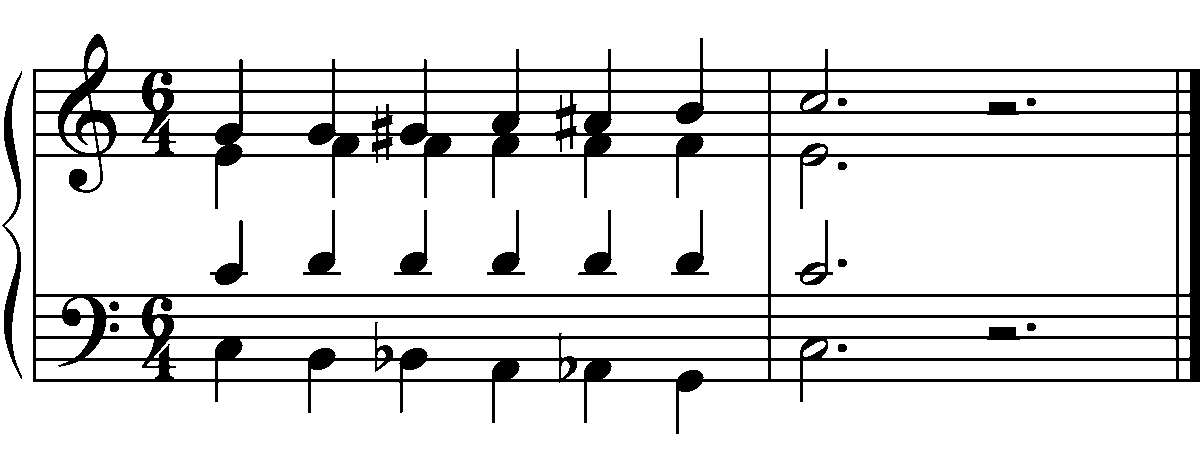
    Here’s a basic harmonic abstract I came up with.  For simplicity’s sake (and because there’s no tonality governing which pitches “need” to appear in each sonority) I kept the inner voices oblique while moving the soprano and bass in opposing directions by half step:

    abstract1

    There does seem to be a subtle natural propulsion to this chordal sequence owing to the strong outer voice motion. However, I know a number of prominent composer/authors who would wag their fingers about “dissonance flow” issues (Persichetti, Hindemtih, Smith Brindle, etc).

    Since I’ve purposely avoided a tonal frame of reference, I decided to think of some other ways I could move voices to keep things interesting.  Also, I took the opportunity to impose more conscious control over dissonance flow:

    abstract2

    Note the outer voices retain the essential “wedge” relationship. The tenor voice is allowed to gradually rise and the alto voice to, more or less, descend (the inner voices being regarded with greater freedom). There are occasionally pitch doublings within individual sonorities; as I had not specifically excluded that as a possibility from the outset and liked how it sounded, I let such instances remain.  The dissonance now seems to flow more smoothly from beginning to end, adding to its emotive and logical satisfaction.

    With my new omnibus-style harmonic succession largely decided upon, I went ahead and experimented with a short composition built around it.  Limiting myself to 16 measures, I selected viola, bells, vibes, and chimes.  I call it Faded Moon.

    Faded Moon (click to enlarge)
    Faded Moon (click to enlarge)

    I tried to make the outer voices most prominent (lightly colored with simple ostinatos in the bells and chimes) to highlight the “wedge” relationship so characteristic of the omnibus progression.  The viola part is a rather fleeting, almost improvisatory solioquy.  Of course this is just a jumping off point for further exploration.  It could be expanded to a multi-section piece or could be part of a suite of characteristic miniatures.  Liberties could be taken with the pitch contents of each sonority (particularly the inner voices) if a more “elegant” flow were sought.

    This project was an interesting challenge. Making sense of the “omnibus” concept without a tonal background required other ways to achieve a sense of motion.  I think I carried it off well but could, if I chose to delve deeper into this project, make improvements upon it.

    (If you want to perform this piece I can get you the pdf.  If you’d like to commission its expansion, drop me a line.)