
Well, maybe not quite Stockhausen-y things here, but definitely not the strict serialistic procedures of Schoenberg et al...
Composition methods, generally speaking, are as “simple” or “complex” as you choose to make them. If you want non-tonal methods of composing that don’t rely on a 12-tone row and its basic operations, I have a few ideas here you can play around with that other composer have found fruitful. Drop me a line here or wherever this article was posted with your own ideas–I’d love to hear them!
The first method involves manipulating intervals. The particular pitches come about as a result of these intervallic relationships.
Here’s one method based on choosing a set of three intervals. Let’s say you wanted to compose a piece that was based around the augmented fourth, the perfect fifth, and the minor second. We choose pitches that fit this description and array them like so:
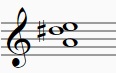
As you can see, there is present all three of our desired intervals. To base a piece of any length on three pitches can of course be done, but most prefer some additional variation. Let’s see what happens when we invert our set of original pitches:
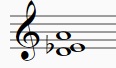
Now we have two additional pitches that stem from our original set. The transposition operation of course can lead in many directions, but let’s do just one to keep our hypothetical piece nice and “tight.”
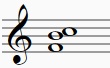
We might also take our original set and expand its compass (i.e., open it up):

You’ll note the augmented fourth was “expanded” into a perfect fifth while we retained the minor second. We could also do the opposite operation, contract the original compass:
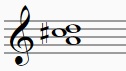
Here the augmented fourth was “contracted” into a major third and the perfect fifth was contracted to a perfect fourth.
A more complex operation involves mirroring the original set around an axis (we’ll pick the pitch A):
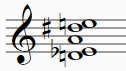
You might observe that, in this case, this is simply the original set combined with the inversion we came up with above.
Let’s compose a little bit with these ideas to illustrate:

The red region uses the pitches of the original set. The blue region uses the inversion set (note that overlapping is fine). The yellow region uses the transposition of the original set. The pink region uses the expansion version of the original set. The dark green region uses the contracted version of the original set.
Of course this is very simple for illustrative purposes. Use your imagination to figure out ways to implement your sets.
We can see even from this though that, although differing pitches are used, they are all based on the same interval seeds. That is what gives this manner of composition it’s sense of cohesion.
Another method (because I promised you more than one) involves taking a chord you like and using it as the basis for melodic material (and also, presumably, accompanimental materials):

We have a chord build of thirds and fifths. We could use this to make a melodic line:
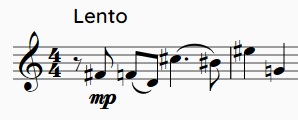
All of the pitches in that line came out of our chosen chord. You could use that chord for a while, then choose a different chord for variety, or apply the variation methods described above to transform the same chord. The other voices, whether contrapuntal or used in other textures, can also make use of these same materials to give the piece cohesion.
So, based on simply choosing a few intervals or a favorite chord, we have several ways of spinning out a piece of music. Happy composing!
 Brandon Nelson
Leave a comment