
I was lurking around one of the composers’ groups on Facebook recently, when I saw that someone had posted about the omnibus progression. It piqued my attention. The term sounded like one I’d come across in my studies, but I’d gotten hazy on the particulars. So, as I normally do when I come across a shiny new musical object, I dropped everything I was doing (probably just homework or child rearing or something) and launched into a Quest for Knowledge.
I found an omnibus progression is one which could, in theory, go on forever without coming to a resolution. It’s characterized by chromatic lines (usually in the outer voices) moving in opposite directions. Over the course of this continuous mutation, dominant seventh chords occasionally result, at which points the composer could opt to stop the progression and modulate. Thus, an omnibus progression could be used as an elaborate dominant prolongation or as a novel way to achieve modulation.
Here’s a simple example to illustrate:
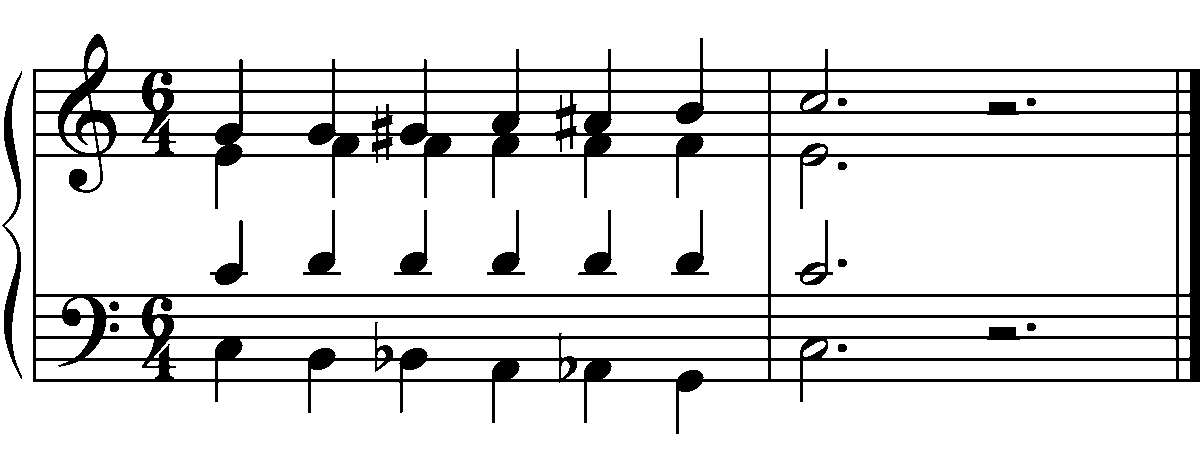
The bass voice descends by half steps while the soprano voice gradually climbs by half steps. On the last beat of the first measure, a G7 chord results, and the composer opts to use it to bring the phrase back to tonic.
I think that’s pretty interesting–simple, elegant, economical, useful.
Like most composers, I like to play around with things and figure out how to make them my own. So I thought, instead of using this in a tonal context, what would happen if the basic principles were applied to “freer” harmonies?
Here’s a basic harmonic abstract I came up with. For simplicity’s sake (and because there’s no tonality governing which pitches “need” to appear in each sonority) I kept the inner voices oblique while moving the soprano and bass in opposing directions by half step:

There does seem to be a subtle natural propulsion to this chordal sequence owing to the strong outer voice motion. However, I know a number of prominent composer/authors who would wag their fingers about “dissonance flow” issues (Persichetti, Hindemtih, Smith Brindle, etc).
Since I’ve purposely avoided a tonal frame of reference, I decided to think of some other ways I could move voices to keep things interesting. Also, I took the opportunity to impose more conscious control over dissonance flow:

Note the outer voices retain the essential “wedge” relationship. The tenor voice is allowed to gradually rise and the alto voice to, more or less, descend (the inner voices being regarded with greater freedom). There are occasionally pitch doublings within individual sonorities; as I had not specifically excluded that as a possibility from the outset and liked how it sounded, I let such instances remain. The dissonance now seems to flow more smoothly from beginning to end, adding to its emotive and logical satisfaction.
With my new omnibus-style harmonic succession largely decided upon, I went ahead and experimented with a short composition built around it. Limiting myself to 16 measures, I selected viola, bells, vibes, and chimes. I call it Faded Moon.

I tried to make the outer voices most prominent (lightly colored with simple ostinatos in the bells and chimes) to highlight the “wedge” relationship so characteristic of the omnibus progression. The viola part is a rather fleeting, almost improvisatory solioquy. Of course this is just a jumping off point for further exploration. It could be expanded to a multi-section piece or could be part of a suite of characteristic miniatures. Liberties could be taken with the pitch contents of each sonority (particularly the inner voices) if a more “elegant” flow were sought.
This project was an interesting challenge. Making sense of the “omnibus” concept without a tonal background required other ways to achieve a sense of motion. I think I carried it off well but could, if I chose to delve deeper into this project, make improvements upon it.
(If you want to perform this piece I can get you the pdf. If you’d like to commission its expansion, drop me a line.)


 Brandon Nelson
Leave a comment